
You can grow a coffee plant at home and enjoy glossy foliage, fragrant flowers, and even a few cherries if you give it the right care. Give it bright, indirect light, steady warmth, and regular moisture, and the plant will stay healthy and may produce fruit over time.
Ethan Cole from Webrewcoffee.com finds that coffee plants reward patient growers with seasonal blooms and a cozy, tropical look that fits indoors or in warm gardens. This guide shows what the plant needs, common problems to watch for, and simple steps to keep it thriving so you can try growing your own beans or just enjoy a beautiful houseplant.
Key Takeaways
- A coffee plant likes bright, indirect light and consistent warmth.
- Regular, even watering and humidity help keep foliage healthy.
- Small harvests are possible at home with proper care.
Overview of the Coffee Plant
The coffee plant is an evergreen woody shrub grown for its seeds, known as coffee beans. It has a clear botanical identity, distinct parts like leaves and cherries, and two main species that power most global coffee production.
Botanical Classification
The coffee plant belongs to the Rubiaceae family and the genus Coffea. Scientists classify it as a woody perennial dicotyledon. This shows it has broad leaves, branching stems, and a long life span compared with annual crops.
Plants have a main vertical trunk and horizontal branches. Flowers form in clusters and develop into fruit called cherries, each usually holding two seeds. Cultivars and varieties exist within species to improve yield, flavor, or disease resistance. Farmers and breeders track these names closely to match plants to climate, pests, and market needs.
Coffee Plant Anatomy
Leaves are glossy, opposite, and usually bright green. They perform photosynthesis and help indicate plant health when they yellow or curl.
Flowers are small, white, and fragrant. They appear along branch axils and, after pollination, become green cherries that ripen red, yellow, or orange depending on variety.
Fruits (cherries) contain the seeds—usually two per cherry—covered by pulp, parchment, and a thin silver skin. Seeds are the beans roasted for coffee. Roots anchor the plant and absorb water and nutrients; they spread shallowly, so mulching and soil care matter. Bark and wood support growth and allow pruning for size control.
Major Coffee Plant Species
Two species dominate coffee farming: Coffea arabica (Arabica) and Coffea canephora (Robusta). Arabica grows best at higher elevations and cooler temperatures. It generally produces sweeter, more complex flavors and lower caffeine than Robusta.
Robusta tolerates hotter, wetter lowland climates and resists many pests and diseases better. It yields more beans per hectare and contains higher caffeine and a stronger, more bitter taste.
Minor species like Coffea liberica and others exist, used locally or for specialty blends. Growers choose species based on elevation, climate, disease pressure, and desired cup profile.
Growth and Lifecycle

Coffee plants begin as seeds that need warm, moist soil, then grow into shrubs that flower and produce cherry-like fruit. They take about three to four years before yielding their first harvestable cherries and continue producing for many years with proper care.
Planting and Germination
Seeds are best planted within days of being removed from the cherry. They require shaded nurseries, loose loam soil, and consistent moisture to sprout. Germination usually occurs in 2–3 months, though cooler conditions slow this to 4–6 months.
Young seedlings need filtered light and protection from wind and direct sun. Growers often transplant seedlings into larger bags for 6–12 months before placing them in the field. Spacing at planting commonly ranges from 1.5 to 3 meters apart depending on variety and terrain.
For more on seed handling and nursery methods, consult guidelines from the Food and Agriculture Organization or the specialty coffee trade groups.
Flowering and Fruiting
Coffee plants typically flower after 2–3 years, often following heavy rain. Flowers are small, white, and fragrant; they open for just a few days. A single plant can produce many flower clusters across its branches.
Pollination is mainly by insects and wind, and successful pollination leads to green cherries. Cherries mature over 6–9 months; they turn yellow then red when ripe. Farmers monitor color and firmness to schedule hand or mechanical picking.
Pruning and shade management influence flowering intensity. Well-timed fertilization improves flower set and fruit retention, which directly affects yield and cup quality.
Maturation Stages
After fruit set, cherries pass through distinct color and density changes. Early stages show green, firm cherries; mid-stages soften and increase in sugar; final ripe stage is red (or sometimes yellow) with a sweet aroma. Ripening time varies by altitude and climate.
Harvesters sort cherries by ripeness; ripe cherries yield the best flavor. Post-harvest processing methods—wet, dry, or honey—then remove pulp and dry seeds to safe moisture levels (about 10–12%). Proper drying and storage prevent mold and preserve bean quality.
Plant age matters: first commercial harvests occur around year three or four, peaks often arrive in years 4–10, and with care plants can remain productive for decades. For technical resources on harvesting and processing, see guidance from agricultural extensions and specialty coffee associations.
Environmental Requirements
Coffee plants need steady temperatures, balanced rainfall, and rich, well-drained soil. They prefer moderate shade, consistent humidity, and protection from strong wind and frost.
Optimal Climate Conditions
Coffee plants grow best where temperatures stay between 15°C and 24°C (59°F–75°F) for Arabica, and 24°C–30°C (75°F–86°F) for Robusta. They suffer when nights drop below 10°C (50°F) or days rise above 30°C (86°F). Stable temperatures support flowering and fruit set.
Altitude matters: Arabica thrives at 600–2,000 meters (2,000–6,500 ft) depending on latitude, which gives cooler nights and slower cherry development that improves flavor. Robusta does well at lower elevations and tolerates warmer, more humid conditions.
Rainfall should be 1,200–2,200 mm (47–87 in) per year, with a distinct dry period of 1–3 months to trigger flowering. Excessive rain during harvest increases disease risk. Wind protection and partial shade (30–50%) help prevent leaf scorch and fruit loss.
Soil Preferences
Coffee prefers deep, fertile soils with good drainage and a slightly acidic pH of 5.5–6.5. Volcanic loam and well-structured sandy loam supply minerals and allow roots to access oxygen. Heavy clay that holds water can cause root rot and stunt growth.
Organic matter is important. At least 3–5% organic content improves water retention and nutrient cycling. Farmers add compost, leaf litter, or green manure to boost fertility. Soil testing guides balanced fertilization of nitrogen, phosphorus, and potassium for steady growth and bean quality.
Avoid compacted or saline soils. Raised beds, mulching, and contour planting reduce erosion on slopes. Good soil management reduces the need for chemical inputs and supports healthier trees.
Watering Needs
Coffee needs steady moisture but not waterlogged roots. Aim for consistent soil moisture that moistens the top 20–40 cm (8–16 in) of soil. Irrigation during dry spells keeps trees productive, especially during flowering and fruit development.
Drip irrigation works well because it delivers water directly to the root zone and reduces disease risk. Frequency depends on soil type: sandy soils need more frequent, shorter watering; loamy soils need less frequent, deeper watering. Mulch conserves soil moisture and keeps roots cool.
Avoid long standing water. Proper drainage, raised rows, or trenches prevent oxygen loss to roots and lower fungal disease pressure. Monitoring soil moisture and adjusting water timing improves yields and bean quality.
Geographic Distribution
Coffee grows in a narrow band around the equator where temperatures, rainfall, and soil suit the plants. Major producing countries, the role of elevation, and the differences between wild and farmed coffee shape where and how coffee plants thrive.
Coffee Producing Regions
Coffee farms cluster in the “Bean Belt” between roughly 25° North and 30° South latitude. Key countries include Brazil, Vietnam, Colombia, Ethiopia, and Indonesia. Brazil leads in volume, mainly Arabica and Robusta, while Ethiopia is known for wild Arabica diversity and distinctive cup profiles.
Tropical highlands in Central and South America, East Africa, and parts of Southeast Asia supply most specialty coffee. Many countries depend on coffee exports for income and jobs. For further reading on global growing zones and climates, the International Coffee Organization offers detailed production data.
Altitude Effects
Altitude strongly affects coffee flavor and growth. Arabica typically prefers 600–2,200 meters above sea level. Higher altitude slows cherry maturation, which concentrates sugars and acids and often yields brighter, more complex flavors.
Robusta grows at lower elevations, usually below 800 meters, and tolerates hotter, more humid conditions. Temperature shifts with elevation also impact disease pressure: cooler highlands reduce pests like coffee berry borer, while lowland farms face more pressure and may require different management.
Wild vs. Cultivated Growth
Wild coffee populations occur mainly in African forests, especially in Ethiopia and parts of Uganda. Wild plants show high genetic diversity, with many unique traits useful for breeding disease resistance and new flavors.
Cultivated coffee is grown on farms and plantations with selected varieties and managed shade, pruning, and harvesting. Farmed coffee often focuses on yield, uniformity, and marketable cup quality. Conservation groups and research centers like the CGIAR Centers study wild coffee genetics to help farmers improve cultivated stocks.
Varieties and Cultivars
Coffee plants include many species and hundreds of named varieties and cultivars. Some varieties are prized for flavor, others for yield or disease resistance, and breeders mix traits to suit climates and farms.
Arabica vs. Robusta
Arabica (Coffea arabica) and Robusta (Coffea canephora) differ in taste, growing needs, and market role. Arabica generally has milder, more complex flavors and lower caffeine. It prefers cool, high-altitude farms between 1,000–2,000 meters and is more sensitive to rust and frost. Robusta has stronger, sharper taste, higher caffeine, and more bitterness. It grows well at lower altitudes, tolerates heat and pests, and yields more per hectare.
Key trade-offs:
- Arabica: higher price, specialty demand, needs careful management.
- Robusta: cheaper, disease-hardy, used in blends and instant coffee.
Specialty Varieties
Specialty varieties focus on unique flavor and origin. Examples include Gesha (Gesha) known for floral and tea-like notes, Bourbon prized for sweetness, and Typica for balanced, clean cup profiles. Farms often choose varieties by microclimate and market goals.
Characteristics producers consider:
- Flavor profile (fruity, floral, chocolate)
- Cup scoring potential (specialty grades)
- Local adaptation (altitude, rain patterns) Smallholder farms may grow landraces and heirloom types that fetch high prices at specialty auctions when processing and harvest are excellent.
Hybrid Coffee Plants
Hybrids combine traits from two or more parent lines to solve farm problems or improve quality. Breeders cross Arabica with disease-resistant lines or develop Arabica-to-Arabica hybrids for yield and cup quality. Notable programs include hybrids bred for coffee leaf rust resistance and drought tolerance.
Common hybrid goals:
- Increase disease resistance
- Raise yield and uniformity
- Preserve or enhance cup quality Farmers often choose hybrids like those from research centers when conventional varieties fail in a region. Hybrids can stabilize income by reducing losses from pests and climate stress.
Pests and Diseases Affecting Coffee Plants
Coffee plants face insect pests that eat cherries, leaves, and stems, and fungal diseases that rot roots or blemish leaves. Farmers must spot signs early, because targeted actions—like traps, pruning, and fungicides—limit damage and protect yield.
Common Pests
The coffee berry borer (Hypothenemus hampei) bores into cherries and destroys beans from the inside. Look for small entry holes on cherries and premature fruit drop. Traps baited with ethanol–methanol blends, timely harvesting, and removing infested cherries reduce spread.
The coffee leaf miner and mealybugs chew leaves or suck sap, causing yellowing and leaf drop. Inspect lower leaf surfaces and new shoots weekly. Natural enemies like predatory ants and parasitic wasps help control populations. Use sticky traps, selective insecticides, or biopesticides when thresholds are exceeded.
Stem borers and scale insects weaken branches and lower tree vigor. Pruning out bored stems and applying horticultural oil to scale hotspots limits outbreaks. Rotate control methods to avoid resistance and preserve beneficial insects.
Major Diseases
Coffee leaf rust (Hemileia vastatrix) produces orange powdery lesions on the leaf underside, then causes defoliation and reduced yield. Monitor during wet seasons and treat with copper fungicides or systemic fungicides as needed. Plant resistant varieties where available.
Root rot (caused by Phytophthora spp.) leads to wilting, yellowing, and brown roots. It worsens in poorly drained soils. Improve drainage, avoid overwatering, and apply fungicides labeled for Phytophthora. Remove severely infected plants to protect nearby trees.
Coffee berry disease and American leaf spot cause dark lesions on cherries and leaves, reducing quality. Sanitation—removing mummified berries—and timely fungicide sprays at flowering and early fruit set lower infection rates. Use certified disease-free seedlings to prevent introduction.
Prevention and Management
Start with healthy seedlings from certified sources to avoid introducing pests or pathogens. Planting shade trees, cover crops, and diverse varieties improves microclimate and reduces pest pressure. Maintain good field hygiene by picking up fallen cherries and pruning diseased branches.
Implement an integrated pest management (IPM) plan: routine monitoring, use of traps, release of natural enemies, and targeted chemical controls only when needed. Record pest levels and actions taken to refine timing and reduce costs. Rotate fungicides and insecticides with different modes of action to prevent resistance.
Soil and water management also matter. Ensure well-drained soil, mulching to conserve moisture, and balanced fertilization to keep plants vigorous. Train workers to spot early signs and act fast; quick removal or localized treatment often stops wider outbreaks.
Harvesting and Processing
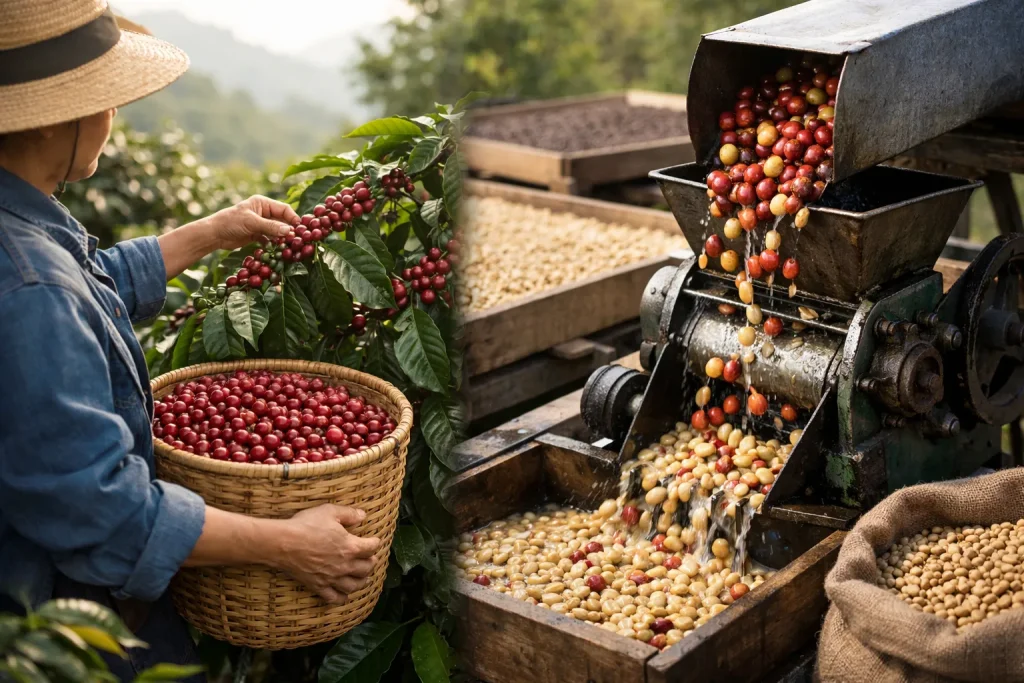
This section explains how ripe cherries are collected, the main ways cherries are turned into green beans, and how those choices change flavor and value.
Picking Methods
Pickers use three main methods: selective hand-picking, strip hand-picking, and machine harvesting.
Selective hand-picking gathers only fully ripe red cherries. It is slow and labor intensive but yields the highest-quality beans. Farms that sell specialty coffee usually pick this way.
Strip hand-picking removes all cherries from a branch in one pass. It is faster and cheaper but mixes ripe and unripe fruit. Many small farms use this when labor is limited.
Mechanical harvesters shake trees or use combing tools. Machines work well on flat terrain and uniform varieties. They lower labor costs but can bruise cherries and collect more defects. Farms choose methods based on slope, labor cost, desired quality, and price targets.
Post-Harvest Processing
After picking, farmers choose a processing method to remove the pulp and dry the beans. The three common processes are washed (wet), natural (dry), and honey (pulped natural). Each needs water, drying space, or both.
Washed processing uses depulping machines, fermentation tanks, and washing channels to remove mucilage. It requires clean water and careful fermentation control to avoid off-flavors. Washed coffees often taste cleaner and brighter.
Natural processing dries whole cherries on patios or raised beds for days to weeks. Workers turn the fruit to prevent mold. Naturals can produce fruity or wine-like notes but need careful drying to avoid ferment or over-fermentation.
Honey processing removes skin and some pulp, then dries the beans with mucilage intact. It balances brightness and body. Drying speed and humidity control strongly affect final flavor.
Impact on Coffee Quality
Picking accuracy and processing method directly shape cup flavor, defect levels, and market price. Ripe-only picking reduces underripe flavors and lowers the number of defective beans. Mixed picking raises the chance of sour or vegetal notes.
Processing controls fermentation and moisture, which change acidity, body, and aromatic profile. For example, washed coffees tend to have higher perceived acidity and clarity. Natural coffees often show heavier body and intense fruit notes.
Practical trade-offs include cost and infrastructure. Higher-quality picking and careful processing demand more labor, water, and drying space, which raise production costs but can qualify beans for higher prices in specialty markets.
Sustainability and Environmental Impact
Coffee farming affects water use, forests, and farmer incomes. It can harm native habitats but also support biodiversity when growers use care and proven practices.
Sustainable Farming Practices
They reduce water and chemical use and improve yields. Techniques include drip irrigation to cut water use by up to 40% and mulch to keep soil moist and reduce erosion. Farmers often use compost and green manures to rebuild soil organic matter and avoid synthetic fertilizers that can leach into streams.
Crop management also matters. Pruning and spacing control pests and boost bean quality, so growers rely less on pesticides. Crop diversification—adding fruit trees or shade trees—provides extra income and reduces risk from price swings or crop failure.
Certification programs (Fair Trade, Rainforest Alliance) can offer price premiums and training. Those programs encourage record-keeping, reduced chemical use, and worker protections, helping farms transition to long-term, lower-impact production.
Biodiversity and Coffee Plantations
Shade-grown coffee preserves tree cover and helps native wildlife. Planting native canopy trees creates habitat for birds, insects, and mammals, and supports pollinators that improve coffee yields.
Sun-grown monocultures clear forests and cut biodiversity. They boost short-term yield but increase soil erosion, require more fertilizer, and raise pest pressure. Converting cleared land back to agroforestry is possible but needs time and investment.
Practical steps include keeping riparian buffers, planting native species, and maintaining mixed-age tree stands. These actions help soil health, store carbon, and provide extra products like fruit or timber for farm families.
Growing Coffee Plants at Home
Coffee plants need bright, indirect light, consistent moisture, and warm temperatures. They can live indoors as houseplants or outdoors in frost-free climates, and they respond well to regular feeding and careful pruning.
Indoor and Outdoor Cultivation
Indoors, place the plant near an east- or west-facing window where it receives bright, indirect light. It tolerates some direct morning sun but burns in hot afternoon rays. Use a well-draining potting mix with peat or coco coir and a pot with drain holes.
Outdoors, plant coffee in partial shade beneath taller trees or shade cloth. It prefers temperatures between 60–75°F (15–24°C) and high humidity. Avoid frost and strong winds. Space plants 6–10 feet apart if grown as small trees. Young plants started from seed can take several years to flower and fruit.
Care Tips for Hobbyists
Water when the top 1–2 inches of soil feel dry; keep soil evenly moist but not waterlogged. Reduce watering in winter. Feed every 4–6 weeks during the growing season with a balanced liquid fertilizer or one higher in nitrogen to support leaves.
Prune to shape and remove dead wood; pinch growing tips to encourage bushiness. Watch for pests like scale, mealybugs, and spider mites and treat with insecticidal soap or horticultural oil. Repot every 2–3 years into a slightly larger pot to refresh soil and encourage root growth. Harvest cherries when they turn red, then process the seeds (beans) by drying and roasting if desired.
Historical and Cultural Significance
Coffee plants began as wild trees in a specific region of east Africa and later moved to the Arabian Peninsula, where people first harvested and brewed the beans. Their spread changed trade routes, daily routines, and social spaces across continents.
Origin of Coffee Plants
Scholars trace wild coffee, mainly Coffea arabica, to the highlands of Ethiopia and nearby regions. Local herders noticed stimulant effects from the red coffee cherries around the 9th century. People in those areas first ate the cherries or mixed them with fat as a portable food.
Cultivation and selective planting started when traders and farmers moved plants to Yemen. There, growers began roasting and brewing the beans by the 15th century. The plant’s move from forest understory to terraced fields shows how humans shaped its form and yield.
Key facts:
| Point | Details |
|---|---|
| Native region | Ethiopian highlands (Kaffa region) |
| Early use | Chewed cherries, mixed in food |
| First cultivation | Yemen, 15th century |
| Species most important | Coffea arabica |
Role in Global Coffee Culture
Coffee plants enabled new social spaces and trade networks from the Middle East to Europe and Asia. Coffee houses emerged in cities like Mecca, Cairo, and later London, becoming hubs for talk, business, and news. Merchants carried seeds and seedlings on trade routes, which spread cultivation to Asia, Africa, and the Americas.
Colonial plantations scaled production in the 17th–19th centuries, changing local economies and labor systems. Today, coffee remains a major global commodity and a daily ritual for millions. It affects farming practices, exports, and cultural habits in producing and consuming countries alike.
Future of Coffee Plant Cultivation
Coffee growers must adapt to hotter temperatures, shifting rainfall, and new pests while also using plant breeding and farm practices to protect yields and quality.
The next decades will hinge on faster development of resilient varieties and smarter farm systems that use less water and fewer chemicals.
Climate Change Challenges
Rising temperatures push Arabica production upward in elevation, but suitable land is limited. Farmers in Mexico and Central America already report moving plots higher by several hundred meters to keep cool nights for flavor.
Rainfall is becoming less predictable. Erratic rains and longer dry spells increase irrigation needs and reduce cherry ripening uniformity. Increased humidity and heat also favor pests and diseases such as coffee leaf rust, which can defoliate trees and force replanting.
Smallholders face the biggest risks. Many lack cash to buy shade trees, irrigation, or disease-resistant seedlings. This leads to lower income and, in some regions, forest clearing to find new land.
Innovations in Coffee Breeding
Breeders focus on varieties that combine high cup quality with resistance to rust, drought, and higher temperatures. Programs use field trials that plant many varieties side-by-side to compare yield, disease response, and bean quality under the same conditions.
New methods include marker-assisted selection and faster crossing cycles to shorten development from decades to years. Non-profit groups and public institutes share genetics and trial data to speed adoption, especially for small farms.
Adoption often pairs breeding with on-farm practices: shade management, drip irrigation, and integrated pest management. These combinations help new varieties perform better while lowering input costs and greenhouse gas emissions.
FAQS
What light does a coffee plant need?
It prefers bright, indirect light. Too much direct sun can scorch leaves, while too little light slows growth.
How often should it be watered?
Water when the top inch of soil feels dry. It likes steady moisture but not soggy roots.
What soil and pH work best?
Use well-draining, rich potting mix with slightly acidic pH (about 6.0–6.5). Good drainage prevents root rot.
How often should it be fed?
Feed every two weeks in spring and summer with a balanced, diluted fertilizer. Cut back in fall and stop in winter when growth slows.
Can it bloom and fruit indoors?
Yes, it can flower and form coffee cherries if conditions are right: consistent humidity, light, and cool nights. Fruit may take time and patience.
How big will it grow?
Indoors it usually reaches 3–6 feet. Outdoors in tropical climates it can grow much taller.
What pests and problems should be watched for?
Look for scale, mealybugs, and spider mites. Yellowing leaves often mean overwatering or poor drainage.
Can it handle low humidity?
It prefers higher humidity but will tolerate average indoor air. Misting or a humidity tray helps during dry months.
Quick care checklist:
- Light: bright, indirect
- Water: keep evenly moist, avoid waterlogging
- Soil: rich, well-draining, slightly acidic
- Feed: biweekly in growing season
Conclusion
The coffee plant moves through clear stages from seed to fruit. It needs steady care, the right climate, and good soil to do well.
Farmers and home growers can both enjoy success by matching variety to conditions. Small changes in pruning, shade, and water make a big difference.
With patience and attention, the plant rewards growers with fragrant flowers and ripe cherries. The journey takes years, but the result is a living crop that supports taste, livelihoods, and ecosystems.