
Coffee Plant Facts: Friendly Guide to Growing, Varieties, and Care
You stand a few steps away from the plant that gives your morning cup its flavor. The coffee plant is an evergreen shrub whose berries hold the seeds we roast into coffee, and knowing its types, growth needs, and life cycle helps you choose beans and care for plants. Ethan Cole from Webrewcoffee.com often says that spotting these basics makes coffee taste better and growing one at home much more rewarding.
Explore how leaves, flowers, and cherries shape flavor, what climate and care each variety needs, and simple tips for harvesting or buying smarter beans. This intro will make you curious about the plant behind every cup and ready to learn practical ways to brew, grow, or shop with more confidence.
Key Takeaways
- Know the plant parts and varieties to understand flavor and care.
- Match growing conditions to the coffee type for better plants or beans.
- Simple planting, harvest, and brewing tips improve home coffee quality.
What Is the Coffee Plant?
The coffee plant is an evergreen shrub or small tree that produces the seeds used for coffee. It has glossy leaves, fragrant white flowers, and red or purple fruit called cherries that hold the coffee beans.
Botanical Classification
The coffee plant belongs to the genus Coffea in the Rubiaceae family. Botanists list about 125 Coffea species, most of which grow as shrubs or small trees. Plants in this genus have opposite leaves and simple, smooth-margined blades. Flowers appear in clusters and are typically white and fragrant, which helps attract pollinators like bees.
Coffee plants produce fruit called cherries. Each cherry normally contains two seeds — the coffee beans — though some cherries hold a single seed called a peaberry. The seeds contain high levels of caffeine and other compounds that affect flavor and aroma after roasting.
Main Coffee Species
Two species supply nearly all commercial coffee: Coffea arabica and Coffea canephora (commonly called Robusta). Arabica plants grow at higher elevations, yield milder, more complex flavors, and account for roughly 60–70% of global production. Robusta tolerates warmer, lower-altitude sites, has higher caffeine content, and gives a stronger, more bitter cup.
Producers also cultivate other species and many hybrids and cultivars to improve yield, disease resistance, and taste. Farmers choose varieties based on climate, altitude, disease risk, and market demand. Processing and roasting further shape the final flavor of the coffee beans.
Origins and History
Coffee’s wild ancestors come from tropical Africa, especially Ethiopia, and parts of tropical Asia. Historical records show coffee spread from Africa into the Arabian Peninsula by the 15th century, where it was first cultivated and traded. Yemen became an early center for coffee cultivation and distribution across the Middle East and into Europe.
European colonial trade and plant transfers in the 17th and 18th centuries moved coffee plants to Asia and the Americas. New growing regions and selective breeding created many cultivars. Today, coffee is economically important in regions between the Tropics of Cancer and Capricorn, with major producers like Brazil, Vietnam, Colombia, and Ethiopia.
Coffee Plant Anatomy
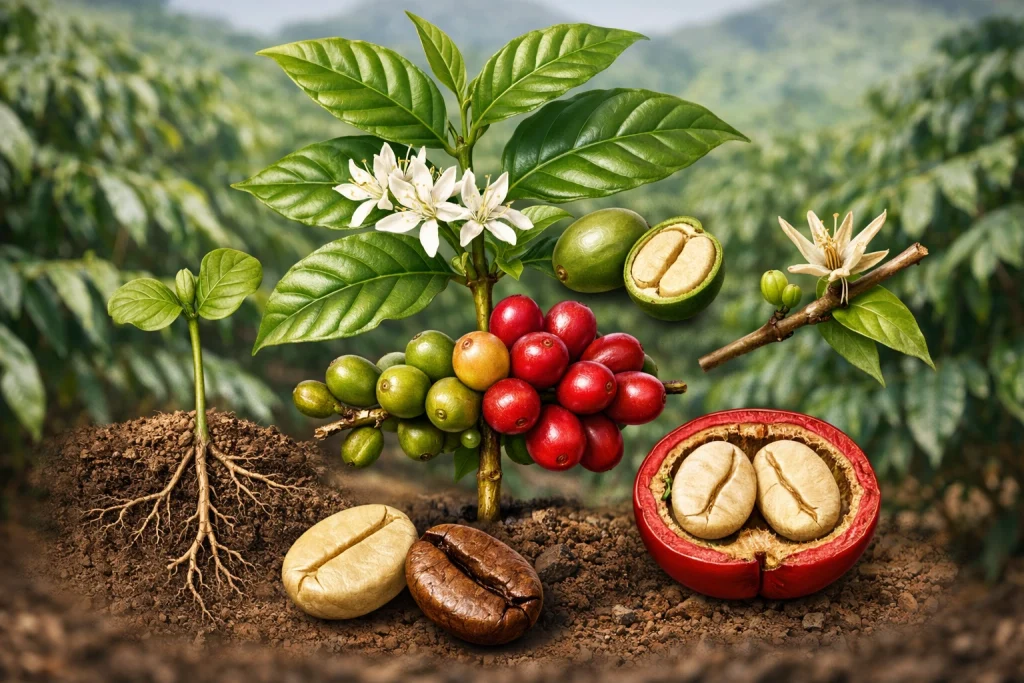
The plant has distinct parts that work together to make coffee beans: leafy growth that captures light, flowers that set fruit, and cherries that protect and hold the seeds. Each part affects coffee yield and bean quality.
Leaves and Stems
Leaves are glossy, opposite, and typically 7–15 cm long on mature Coffea arabica and Robusta plants. They perform photosynthesis and store sugars that feed developing berries. Healthy, dark green leaves signal good nitrogen status and steady growth.
Stems form the scaffold of the bush or small tree. New shoots, called plagiotropic branches, bear most flowers and cherries. Pruning manages branch length and density to keep light reaching inner leaves and reduce disease risk.
Key care points:
- Monitor for yellowing or spots that suggest nutrient deficiency or leaf rust.
- Maintain balanced fertilization and shade to prevent leaf scorch.
- Use selective pruning to encourage productive branches and simplify harvests.
Flowers and Pollination
Coffee flowers are small, white, and fragrant, appearing in clusters along branches. They bloom after rains and often open for only a day or two. A single tree can flower multiple times in a year depending on climate.
Bees and other insects perform most pollination, though some self-pollination occurs in Arabica. Successful pollination leads to fruit set within a few weeks. Poor pollination reduces yield and creates uneven cherry ripening.
Grower practices that improve pollination and fruit set:
- Protect pollinator habitat and avoid broad-spectrum insecticides.
- Time pruning and irrigation to match natural bloom cycles.
- In some farms, introduce bee hives to boost fruit set and uniformity.
Coffee Cherries
Coffee cherries start green, then turn yellow, pink, and finally red or deep purple when ripe. Each cherry normally holds two seeds (beans); a single seed forms a peaberry. The outer skin (exocarp), pulpy flesh (mesocarp), and parchment (endocarp) protect the seeds.
Ripening time varies: 6–9 months for Arabica in many regions. Uniform ripeness matters for taste; overripe or underripe cherries harm cup quality. Farmers harvest by selective handpicking or mechanical stripping depending on terrain and labor.
Processing hinges on cherry condition:
- Washed processing removes pulp quickly to control fermentation.
- Natural processing dries whole cherries to develop fruity flavors.
- Monitor moisture and drying rates to prevent mold and off-flavors.
For more on Coffea species and their traits, see the Royal Society of Chemistry overview and the Coffea genus entry at Wikipedia.
Growth Cycle and Development
The coffee plant moves from seed to fruit through clear steps. Each step needs specific care: warm soil and shade for seedlings, steady pruning and feeding for growth, and correct rainfall and temperature for flowering.
Seed Germination
Seeds usually sprout within 1–4 weeks when kept warm and moist. They need a consistent temperature around 20–25°C (68–77°F) and damp, well-draining soil. Nurseries often sow seeds in trays or beds and keep them shaded to prevent leaf scorch.
Young seedlings show their first true leaves after the cotyledons. They stay under shade for about six months to avoid sun stress. Fertilizer is light at this stage; too much nitrogen can harm root development.
Transplanting to larger pots or fields happens when seedlings reach 10–15 cm tall and have a few sets of leaves. Planting depth should keep the root collar just below soil level to stabilize growth.
Stages of Maturity
After transplanting, the plant focuses on vegetative growth for 2–4 years before regular fruiting. Height, branch number, and leaf area increase rapidly with proper watering and balanced fertilizer. Farmers often train stems and prune to shape the canopy and improve light penetration.
Flowering and fruiting cycles start around year 3–4 for Arabica and slightly earlier for Robusta. A mature coffee tree can keep producing for many years if pests and diseases are controlled. Yield depends on variety, climate, and care.
Routine tasks include mulching, pest monitoring, and periodic pruning. Farmers may apply phosphorus and potassium during fruit set to support cherry development and calcium to strengthen tissues.
Blooming Season
Flowering follows a trigger like heavy rain after a dry spell. Flowers open for a short window—usually 1–3 days—and release a strong jasmine-like scent that attracts pollinators. Each flower can become one coffee cherry.
The bloom-to-cherry cycle takes several months. After pollination, cherries ripen over 6–9 months depending on temperature and variety. Even ripening matters: uneven rains or poor nutrition produce mixed maturity and lower cup quality.
Producers time fertilizer and irrigation around bloom to maximize fruit set. Many use shade management to buffer temperature swings during this sensitive period.
Ideal Growing Conditions
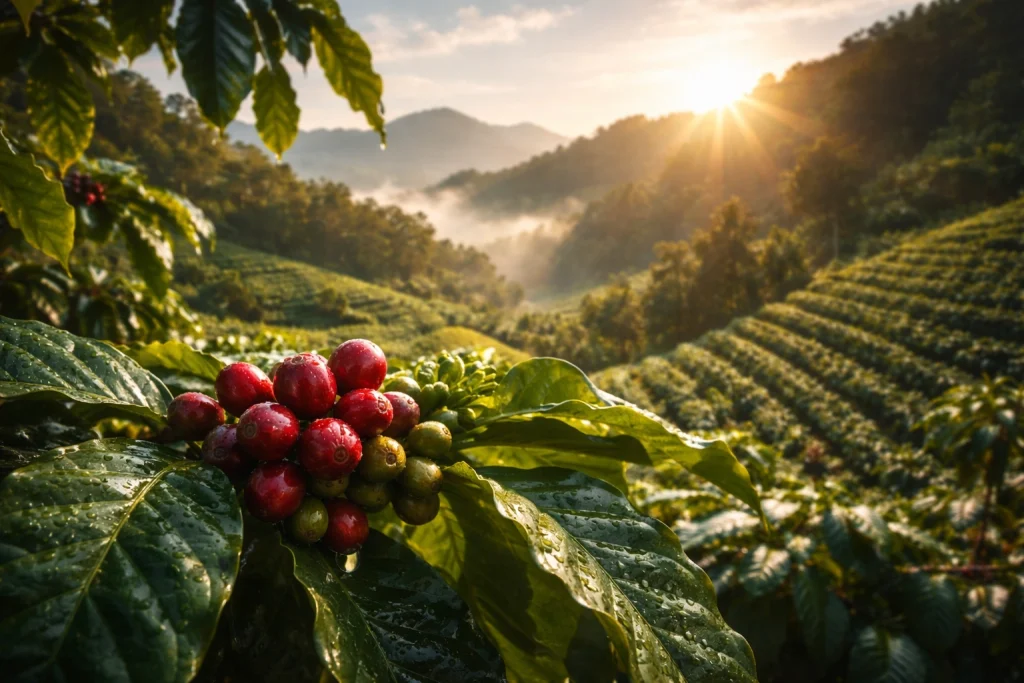
Coffee plants need steady warmth, consistent moisture, and slightly acidic, well-drained soil. Light levels, humidity, and altitude also shape bean quality and plant health.
Climate Requirements
Coffee grows best where temperatures stay between 15°C and 30°C (59°F–86°F). Temperatures below 10°C can slow growth and risk frost damage. Sudden heat above 30°C stresses the plant and can reduce flowering.
Rainfall should be regular and total about 1,200–2,000 mm per year, with a defined wet season for growth and a short dry season to trigger flowering. Relative humidity around 60–80% supports leaf health and fruit development. Provide dappled shade in hot, sunny sites to prevent leaf scorch and to keep soil moisture stable.
Soil Preferences
Coffee prefers loamy, well-drained soils with good organic matter. Soil texture that holds moisture but drains excess water works best to avoid root rot. Aim for a soil pH of about 5.5–6.5; slightly acidic conditions help magnesium, calcium, and iron stay available.
Regular addition of compost or leaf mulch improves structure and nutrients. Avoid compacted or waterlogged soils; raised beds or mounded rows can help in heavy-clay areas. Balanced fertilization—nitrogen for leaf growth, phosphorus for roots and flowering, potassium for fruit—supports steady yields.
Altitude Effects
Altitude strongly affects temperature and bean flavor, especially for Arabica varieties. Arabica thrives above 900 meters (3,000 feet), where cooler nights slow cherry ripening and enhance acidity and aroma. At higher elevations, expect lower yields but finer cup quality.
Robusta tolerates lower elevations and warmer temperatures and can grow near sea level up to about 800 meters. Higher altitudes reduce pest pressure and may increase susceptibility to cold; growers often choose varieties matched to their elevation to balance yield, disease resistance, and cup characteristics.
Coffee Plant Varieties
Coffee plants show wide differences in flavor, growth needs, and disease resistance. Some types thrive at high altitude with delicate taste, while others tolerate heat and pests but taste stronger. Growers choose varieties for yield, climate, and cup quality.
Arabica Varietals
Arabica (Coffea arabica) includes many named varietals prized for flavor and aroma. Popular ones include Bourbon and Typica, which often give sweet, balanced cups. more recent cultivars like Caturra and Catuai were bred for higher yield and easier harvest, though they may trade some complexity.
Arabica grows best above 1,000 meters in cool, stable climates. It is more susceptible to coffee leaf rust and pests than other species, so farmers pick rust-resistant lines like Castillo or Catimor in areas with disease pressure. Specialty roasters often list the varietal on the bag when the bean’s unique flavor matters.
For technical detail, World Coffee Research maintains a catalog of many arabica varieties and breeding goals. This helps farmers match varieties to local climate and market demand.
Robusta Characteristics
Robusta (Coffea canephora) grows at lower altitudes and tolerates heat and humid conditions. It produces higher yields and resists diseases and pests better than arabica. Robusta beans have more caffeine and more bitter, earthy flavors, often used in espresso blends for crema and strength.
Robusta plants are typically bushier and more productive per hectare. They need less shade and mature faster, which suits large-scale plantations. Quality-focused producers sometimes blend small amounts of Robusta into mixes, but single-origin Robusta remains less common in specialty markets.
For species info and horticulture context, encyclopedic sources like Britannica describe Robusta’s botanical traits and global role in coffee production.
Lesser-Known Species
Beyond arabica and robusta, a few other Coffea species appear in commerce or local markets. Liberica (Coffea liberica) has large, irregular beans and a floral, woody profile. It grows well in hot, wet regions and supplies niche markets in the Philippines and parts of West Africa.
Other species include excelsa and many wild types found in Africa’s forests. These can offer unique flavors and genetic traits useful for breeding. Conservation of wild coffee diversity helps breeders develop disease resistance and climate resilience for future crops.
Cultivation and Care
Coffee plants need bright, indirect light, consistent moisture, and steady humidity. They prefer rich, well-draining soil and benefit from regular shaping and pest checks.
Pruning Techniques
Prune to shape the plant and to keep airflow through the canopy. Remove dead, weak, or crossing branches at the base. For young plants, pinch back the growing tip to encourage bushy growth and more lateral branches.
For productive shrubs, thin older stems every 1–2 years. Cut branches back to a healthy outward-facing bud or to the main trunk. When pruning after harvest, remove up to one-third of the canopy to stimulate new shoots.
Use clean, sharp tools to make angled cuts. Sterilize tools with rubbing alcohol between cuts when disease is suspected. Dispose of removed material; do not compost diseased wood.
Fertilization
Feed coffee plants with a balanced, water-soluble fertilizer during the growing season. A common ratio is 10-10-10 or 20-20-20 applied every 4–6 weeks for potted plants. Reduce or stop feeding in winter when growth slows.
For outdoor or larger plants, use slow-release granular fertilizer in spring and again midseason. Aim for slightly acidic soil (pH 6–6.5); add sulfur or peat moss if pH is too high. Watch leaf color: pale leaves often signal nitrogen deficiency, while brown leaf edges may mean potassium or salt buildup.
Always water before applying fertilizer to avoid root burn. Follow label rates and reduce dose to half for young plants or after repotting.
Pest and Disease Control
Inspect leaves and stems weekly for pests such as scale, mealybugs, aphids, and spider mites. Look for sticky residue, tiny webbing, or white cottony spots. Early detection makes treatment easier.
For small infestations, wipe insects off with a damp cloth or spray with insecticidal soap. For heavier problems, use horticultural oil or a targeted systemic insecticide following product instructions. Treat indoors on a sink or balcony to avoid drift.
Prevent fungal diseases by avoiding overwatering and ensuring good air circulation. Remove fallen leaves and keep the crown dry. If root rot appears, trim affected roots, repot into fresh well-draining mix, and cut back watering until the plant recovers.
Coffee Harvesting and Processing
This section explains how ripe cherries become green beans ready for roasting. It covers how harvest choices affect flavor, and the main steps used to remove fruit and dry the beans.
Harvesting Methods
Farmers pick coffee cherries either by hand or by machine. Hand picking lets workers sort cherries on the tree, selecting only fully ripe, red cherries. This yields higher quality and is common for specialty Arabica grown on steep hills. It is slower and costs more in labor.
Strip picking removes all cherries from a branch at once. It is faster but mixes ripe and unripe fruit, which can reduce cup quality. Mechanical harvesters shake trees or use belts to strip cherries. Machines work best on flat, densely planted farms and on varieties bred for uniform ripening.
Key trade-offs:
- Hand picking: better selectivity, higher cost.
- Strip/mechanical: faster, lower cost, more variability in ripeness.
Processing Techniques
Processing separates the seed (bean) from the cherry and shapes flavor. The main methods are washed (wet), natural (dry), and honey (semi-washed).
Washed: Cherries are pulped, fermented to remove mucilage, then washed and dried. This produces cleaner, brighter flavors and more consistent cups.
Natural: Whole cherries dry on patios or raised beds until the fruit is removed. Beans often gain sweeter, fruit-forward notes but risk uneven fermentation if drying is slow.
Honey: Pulp is removed but some mucilage remains during drying. Results sit between washed and natural—balanced sweetness with some clarity.
Drying and storage matter: beans must reach about 10–12% moisture and be stored dry and cool. Poor drying leads to mold and off-flavors.
Unique Features of Coffee Plants
Coffee plants combine long productive lives with special traits that fit tropical understories. They grow as shrubs or small trees, make fragrant white flowers, and set colorful cherries that house the coffee seeds.
Lifespan and Productivity
Coffee plants can live for many years in the right conditions. Arabica plants typically start producing harvestable cherries at 3–4 years old and reach peak yield between 6–15 years. Robusta often begins bearing earlier and can remain productive longer under warmer, lowland conditions.
Farmers often prune coffee to maintain 2–3 main stems and a limited canopy height. This practice keeps plants vigorous and simplifies harvesting. Yields vary by species, variety, soil, and care; Arabica usually gives lower yields but higher cup quality, while Robusta yields more beans per hectare.
| Species | Typical first harvest | Peak production years | Typical form |
|---|---|---|---|
| Arabica | 3–4 years | 6–15 years | Shrub/tree |
| Robusta | 2–3 years | 5–20+ years | Shrub/tree |
Distinctive Adaptations
Coffee plants evolved several traits for shaded, tropical forests. Their glossy, opposite leaves with smooth edges capture dappled light and reduce water loss. White, jasmine-scented flowers attract pollinators like bees, which improves fruit set for many varieties.
The cherries develop red, yellow, or orange skins that signal ripeness to birds and mammals. Those animals spread seeds across the forest floor. Many Coffea species tolerate acidic soils and rely on mycorrhizal fungi to access nutrients in poor soils, aiding survival in understory habitats.
Fun and Surprising Coffee Plant Facts
The coffee plant has surprising roles in global trade, farming, and even local crafts. Its beans, leaves, and growth patterns shape economies in specific countries and find uses beyond brewing.
Largest Producers Worldwide
Brazil and Vietnam lead the world in coffee production by a wide margin. Brazil grows mainly Arabica and Robusta across states like Minas Gerais and São Paulo. Vietnam focuses on Robusta, with the Central Highlands such as Dak Lak producing most of its crop. Colombia and Indonesia follow, each known for distinct regional flavors: Colombia for high-elevation Arabica and Indonesia for earthy, wet‑processed beans from islands like Sumatra and Java.
Annual output varies by year and weather, but these four countries often supply the bulk of green coffee exports. Smallholder farms dominate production in places like Ethiopia and Honduras, while larger estates appear more in Brazil and Central America.
Uncommon Uses of Coffee Plants
People use parts of the coffee plant beyond drinking brewed coffee. Coffee leaves make a mild tea in some East African and Southeast Asian cultures. Farmers sometimes use coffee husks and pulp as mulch or compost to return nutrients to the soil.
Artisans craft items from dried coffee wood and burl for small furniture or utensils in coffee regions. Some communities ferment coffee cherry pulp to make low‑alcohol beverages or vinegar. Researchers also study coffee plant extracts for natural pesticides and cosmetic ingredients, though these uses remain local or experimental rather than widespread.
FAQS
What is a coffee plant?
It is a small evergreen shrub or tree in the Coffea genus. Many species grow cherries that hold the coffee seeds people roast and brew.
How long before it produces fruit?
Plants often start making marketable cherries at 3–5 years. They can stay productive for about 15–20 years with proper care.
Which species are common?
Arabica and Robusta are the main ones. Arabica is known for milder flavor and high elevation growth. Robusta is tougher and higher in caffeine.
Can it grow outside the tropics?
They prefer tropical, frost-free climates. People can grow them indoors or in greenhouses in cooler regions.
How are the seeds processed?
There are two main methods: washed (wet) and natural (dry). Each method changes the bean’s flavor.
Is caffeine in every cherry?
Most coffee seeds contain caffeine, but levels vary by species. Robusta usually has more caffeine than Arabica.
What about peaberries?
Peaberries occur when one of the two seeds in a cherry fails to form. Some buyers seek them for a different cup profile.
Can coffee plants be ornamental?
Yes. They have glossy leaves, fragrant white blossoms, and red cherries that add visual interest indoors or in gardens.
Conclusion
The coffee plant offers both beauty and use, with shiny leaves, white flowers, and tasty cherries. It grows best in warm, wet places and needs careful care to do well.
Growers and hobbyists learn about types like Arabica and Robusta to choose the best plant for taste and climate. They watch for pests, give rich soil, and pick cherries at the right time.
Knowing the plant’s stages—from seed to bean—helps people enjoy better coffee and stronger crops. Small changes in care can make a big difference in flavor and yield.