
Factors Affecting Coffee Taste: Key Variables From Bean to Cup and How They Influence Flavor
You notice flavor differences from cup to cup because many things shape coffee’s taste before it reaches your mug. From the farm where beans grow to how you grind and brew them, each step adds or removes flavor. Focus on bean type, processing, roast, grind size, water, and brewing method to control the taste you want.
Ethan Cole of Webrewcoffee.com often reminds home brewers that small changes make the biggest difference. Try one change at a time—like adjusting grind or water temperature—to learn what matters most for your cup.
Key Takeaways
- Bean origins and processing set the base flavors you start with.
- Roasting, grinding, and brewing choices refine or hide those flavors.
- Water, storage, and serving habits can make or break a good cup.
Coffee Bean Variety
Different coffee varieties shape acidity, sweetness, body, and aroma. Variety also links to disease resistance and yield, which affect what farmers grow and what roasters buy.
Arabica vs Robusta
Arabica (Coffea arabica) and Robusta (Coffea canephora) differ in flavor and chemistry. Arabica tends to offer brighter acidity, floral or fruity notes, and a sweeter profile. It usually contains less caffeine and more sugars, which create more complex aromas when roasted.
Robusta gives a stronger, harsher cup with more bitter and earthy tones. It has higher caffeine and more lipids, which can add crema in espresso blends but often reduces perceived sweetness.
Producers choose Arabica for specialty coffee because it rewards careful processing and higher altitudes. They plant Robusta where conditions are hot, humid, or where disease pressure is high because it yields more and resists pests. Buyers select beans by price point and desired cup quality.
Single Origin vs Blend
Single origin comes from one farm, region, or country and highlights specific flavors tied to soil, altitude, and processing. It allows drinkers to taste distinct notes like citrus from Ethiopia or chocolate from Brazil. Single-origin beans suit pour-over and tasting flights where clarity matters.
Blends mix beans from multiple origins to balance flavors and mask flaws. Blends aim for consistency across seasons and can combine acidity, sweetness, and body to suit espresso or drip at scale. Roasters design blends to hit target flavor profiles repeatedly.
Cafés choose single origin to showcase terroir and blends to deliver a steady house taste. Home brewers pick based on whether they want variety (single origin) or a reliable everyday cup (blend).
Growing Region
Growing region, or terroir, strongly affects flavor through altitude, soil, and climate. Higher altitudes usually produce denser beans with brighter acidity and more pronounced fruit or floral notes. Lower altitudes often yield fuller-bodied and earthier flavors.
Soil minerals and rainfall patterns shape sweetness and complexity. Volcanic soils can add mineral clarity, while wet, tropical climates may increase fermentation risk during processing. Microclimate factors—shade, temperature swings, and seasonal rains—alter ripening speed and sugar development in the cherry.
Buyers look at regions to predict flavor: East African coffees often deliver citrus and floral notes, Central American beans lean toward chocolate and nutty flavors, and Indonesian coffees commonly show earthy, herbal tones. Farmers match varieties to region to get the best cup and crop resilience.
Bean Processing Methods
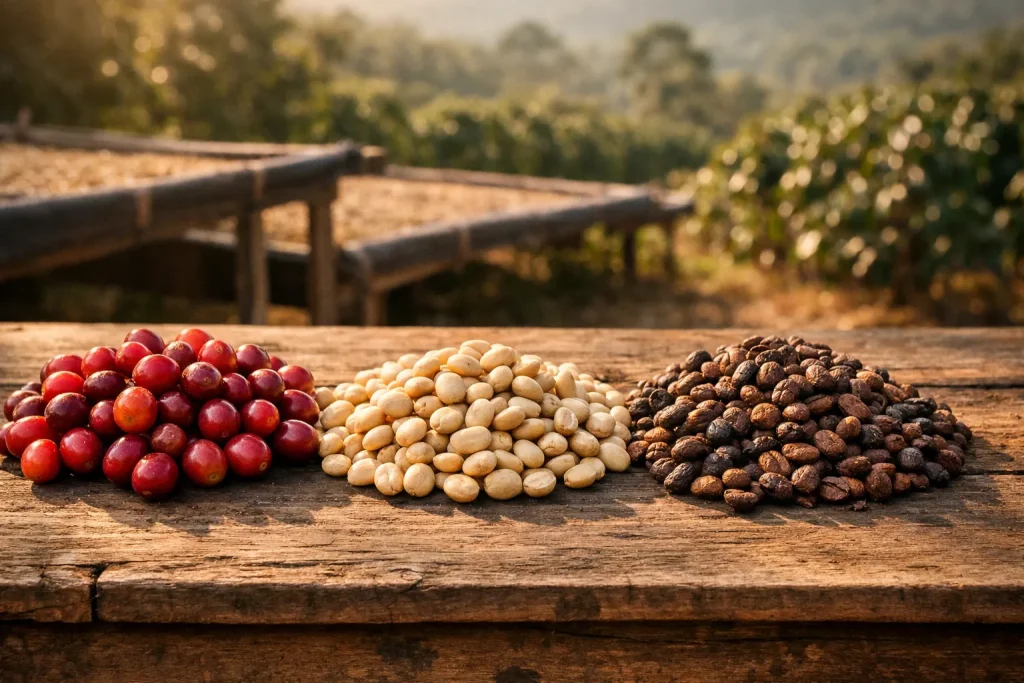
Processing changes the beans’ sugars, acids, and surface chemistry. These changes shape aroma, body, and clarity in the cup by altering fermentation, drying, and how much fruit contact the bean keeps.
Washed Process
The washed process removes the fruit pulp soon after harvesting. Workers use pulping machines, then ferment the beans in water tanks to break down the sticky mucilage. Timed fermentation and thorough washing give more control over acidity and clarity.
Washed coffees tend to highlight bright acidity and clean flavors. Roast development brings forward floral, citrus, and tea-like notes. Drying on raised beds speeds moisture loss and reduces off-flavors, while poor control can lead to vegetal or fermented faults.
Producers in regions with reliable water and processing infrastructure favor this method. For technical background on fermentation and standard practices, refer to the Specialty Coffee Association’s resources: Specialty Coffee Association.
Natural Process
The natural process dries whole cherry fruit on patios or raised beds without removing pulp. Farmers spread cherries thinly, turn them often, and monitor humidity closely to prevent mold. This extended fruit contact increases sugar uptake and complex fermentation notes.
Natural-processed coffees often present heavier body, pronounced sweetness, and fruity or jammy flavors like berry or tropical fruit. These beans can show rustic or fermented edges if drying is uneven or weather interrupts the process. Consistency depends on careful sorting and drying protocols.
Regions with dry climates and lower water availability commonly use this method. Many specialty producers use mechanical dryers or controlled solar tunnels to reduce weather risk and preserve fruit-forward character.
Honey Process
The honey process removes the skin but leaves some mucilage on the parchment during drying. Producers classify honey by color—white, yellow, red, or black—based on how much mucilage stays and how long it dries. This balance influences sweetness and body.
Honey-processed coffees combine the clarity of washed coffee with the sweetness and fruit notes of naturals. They often show syrupy body, caramel, and stone-fruit tones with moderate acidity. Drying management is critical; uneven drying creates fermentation hotspots and off-flavors.
This method suits farmers seeking flavor complexity without full natural fermentation. World Coffee Research offers guidance on processing impacts and best practices for quality control: World Coffee Research.
Roasting Techniques
Roasting changes green beans into the flavors and aromas in a cup. Time, temperature, and method decide whether a coffee tastes bright, sweet, bitter, or smoky.
Roast Levels
Roast levels range from very light to very dark and shape acidity, body, and sweetness. Light roasts keep more origin character, with floral, fruity, and bright acidity. They often show single-origin notes and are good for pour-over or drip brewing that highlights subtle flavors.
Medium roasts balance acidity and body. They develop more caramel and chocolate notes while preserving some origin traits. This level suits espresso and filter methods for a rounded cup.
Dark roasts reduce acidity and increase bitterness and roast-derived flavors like smoke and toasted sugar. They hide origin differences and work well in milk-based drinks. Roast color, surface oil, and first/second crack points help roasters hit a target profile.
Freshness of Roast
Freshly roasted coffee contains volatile aroma compounds that fade over days to weeks. Degassing happens quickly: CO2 and aromatics peak in the first 24–72 hours, so many roasters recommend resting beans 1–3 days before brewing to avoid uneven extraction.
Flavor changes continue for up to two weeks; citrus and floral notes drop first while body and roast notes become stronger. Whole beans keep freshness longer than pre-ground coffee because grinding increases surface area and speeds up staling. Store beans in an airtight, opaque container at room temperature and use them within two to four weeks for best flavor.
Roasting Equipment
Different machines change heat transfer and airflow, affecting flavor consistency. Drum roasters use conduction and rotation for even color and longer roast times, which can bring out deeper caramelization. Air or fluid-bed roasters use hot air to suspend beans, producing cleaner, brighter cups and faster roast curves.
Home roasters and sample roasters give control but less consistency than commercial machines. Equipment variables—drum material, burner type, airflow rate, and cooling method—alter how quickly beans pass through Maillard reactions and first/second crack. Producers often follow standards from groups like the Specialty Coffee Association or research from World Coffee Research to refine profiles and improve repeatability.
Grinding Factors
Grinding controls how fast and how evenly water extracts oils, acids, and sugars from beans. Two main influences are the particle size and the grinder mechanism; both shape flavor clarity, strength, and mouthfeel.
Grind Size
Grind size sets extraction speed. Coarse grounds (like for French press) slow extraction and reduce bitterness, yielding a fuller body but fewer bright notes. Fine grounds (espresso) speed extraction, boosting concentration and crema while risking over-extraction and harshness if too fine.
A mismatch between grind and brew method creates common faults:
- Too coarse for drip or espresso → weak, sour taste.
- Too fine for pour-over or French press → bitter, muddy taste.
Adjust grind in small steps when tuning flavor. Note that particle distribution matters: uniform particles extract more evenly, revealing cleaner flavors. Grinding just before brewing preserves volatile aromatics that make single-origin and light roasts taste best.
Grinder Type
Blade grinders chop beans inconsistently. They produce mixed particle sizes, which cause uneven extraction and muddled flavor. They are affordable but limit control over taste.
Burr grinders crush beans between two surfaces. Burrs produce uniform particles and allow precise control of grind setting. Conical and flat burrs both work; conicals often run cooler and are quieter, while flat burrs can yield extremely consistent particle size for espresso.
For home use, a good-quality burr grinder improves clarity and repeatability. For espresso or precise brewing, choose a grinder with stable burrs and small incremental adjustments. Regular cleaning and burr replacement keep performance steady.
Brewing Variables
These variables determine how much flavor and which compounds extract from the grounds. Small changes to temperature, time, or ratio can shift acidity, sweetness, bitterness, and body.
Water Temperature
Temperature controls which compounds dissolve and at what rate. Brewing between 90–96°C (195–205°F) extracts a balance of acids, sugars, and bitters. Lower temps favor acidic and floral notes but can leave the cup weak. Higher temps pull more sugars and bitters, which can increase body but risk harshness.
Espresso uses higher pressure and slightly higher effective extraction temperatures, while cold brew sits near room temperature or colder and extracts slowly, emphasizing sweetness and low acidity. Use a thermometer or kettle with temperature control to hit a target within ±2°C (±4°F). Adjust in 1–2°C steps to tune taste.
Brewing Time
Time governs how long water contacts the grounds and which molecules move into the cup. Short contact under-extracts: coffee tastes sour, thin, or underdeveloped. Long contact over-extracts: coffee becomes bitter and astringent.
Recommended ranges: espresso 20–30 seconds, pour-over 2.5–4 minutes, French press 3.5–5 minutes, and cold brew 12–24 hours. If coffee tastes sour, increase time; if it tastes bitter, decrease time. Grind size and agitation affect effective time, so change one variable at a time.
Coffee-to-Water Ratio
The ratio sets brew strength and affects perceived balance. Common starting points: 1:15 to 1:18 (mass ratio coffee). A 1:16 ratio yields a medium strength cup for many methods. Use a scale to measure grams of coffee and water for repeatable results.
If the cup feels weak, increase coffee mass (move toward 1:15). If too strong or heavy, dilute toward 1:17–1:18. Adjust ratio in 0.5–1.0 increments and taste. Note that changing ratio may require slight tweaks to grind size, temperature, or time to maintain balanced extraction.
Water Quality
Water chemistry and cleanliness shape how coffee extracts. Minerals change sweetness, body, and acidity, while impurities and treatment byproducts can mute or add off-flavors.
Mineral Content
Minerals like calcium, magnesium, and bicarbonate affect how coffee dissolves. Calcium and magnesium help extract oils and soluble solids, which add body and perceived sweetness. Too little mineral content (very soft water) often yields thin, sour-tasting coffee because acids dominate extraction.
Bicarbonate buffers acidity. Moderate bicarbonate can smooth bright beans; high bicarbonate levels will flatten acidity and make coffee taste dull or soapy. Target ranges many baristas use: 50–150 ppm total hardness and 40–75 ppm bicarbonate, though exact numbers vary by bean and brew method.
Adjusting minerals works by blending distilled water with a mineral source or using a commercial mineral packet. Small changes matter; add minerals incrementally and taste after each change.
Water Purity
Purity covers chlorine, chloramine, metals, and organic contaminants. Chlorine and chloramine in tap water often produce clear off-flavors—chemical, medicinal, or metallic—that mask coffee’s delicate notes.
Filters such as activated carbon remove chlorine and many organic compounds. Reverse osmosis (RO) removes most dissolved solids and contaminants but also strips beneficial minerals. Many brewers combine RO with a remnant mineral addition to reach desired hardness.
They should test water with simple strips or send a sample to a lab if flavor problems persist. Regular maintenance of filters and plumbing prevents scale, rust, and biofilm that can taint brew taste.
Storage Conditions
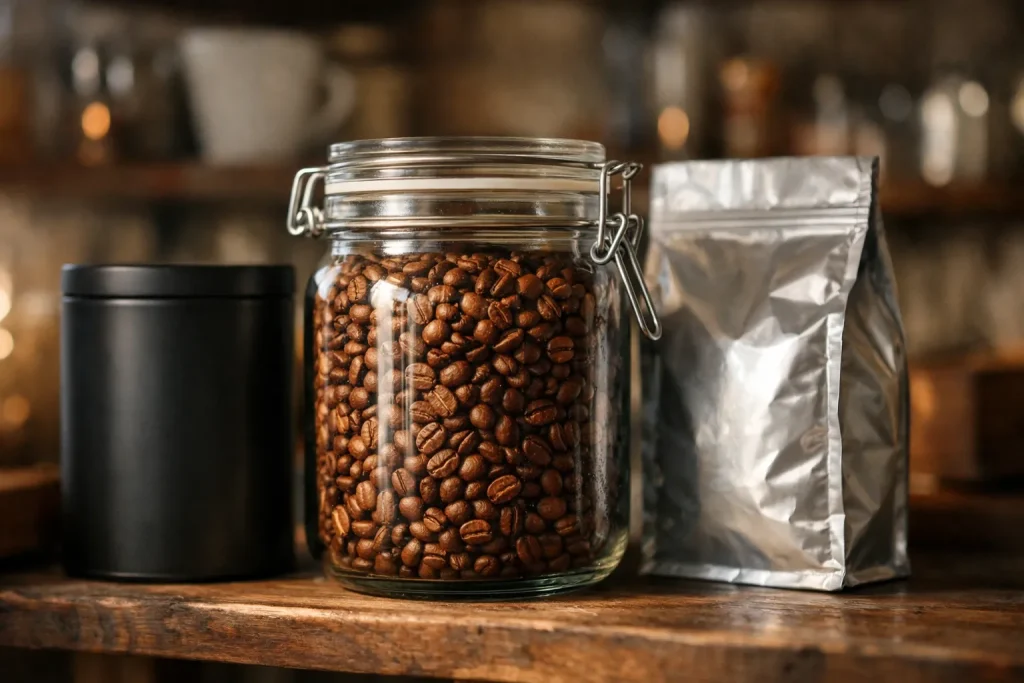
Proper storage keeps coffee closer to the flavor it had after roasting. The main risks are oxygen, moisture, heat, and light; controlling these preserves aroma and taste.
Exposure to Air
Oxygen reacts with coffee oils and volatile compounds, causing rapid flavor loss. Once a bag is opened, beans begin to oxidize; ground coffee oxidizes faster because of greater surface area. Store beans in airtight containers with a one-way valve if possible to release CO2 without letting air in.
Buy only what will be used within 1–2 weeks for peak flavor. For longer storage, divide coffee into smaller sealed portions to avoid repeatedly exposing the whole supply to air. Avoid scooping directly from a large bag; transfer a small daily portion to a separate container.
Light and Temperature
Light and heat accelerate chemical reactions that dull sweetness and aroma. Direct sunlight, stoves, or warm windowsills raise temperature and should be avoided. Ideal storage sits in a cool, dark place between 15–20°C (59–68°F).
Use opaque containers to block light and keep them away from ovens, kettles, and sunny counters. Refrigerators add moisture and odors; they are not recommended for daily-use beans. For long-term storage, freeze unopened portions in airtight bags and thaw before opening to limit condensation.
Serving Practices
Serving choices change how coffee smells and tastes. Material of the cup affects heat loss and flavor perception. Serving temperature changes which flavors appear and how bitter or sweet the coffee seems.
Cup Material
Different cup materials alter heat retention and flavor pickup. Porcelain and ceramic hold heat well and don’t add flavors, so they keep temperature steady and let the coffee’s natural aroma come through. Glass shows color and crema but cools faster, which can mute aroma and make the coffee taste flatter sooner.
Metal cups, like stainless steel, cool or heat quickly and can give a metallic note if thin. Paper and Styrofoam insulate but may add faint off-odors and change mouthfeel. For tasting or table service, choose thick-walled ceramic or double-walled glass to balance heat retention and neutral flavor.
Serving Temperature
Temperature strongly shifts perceived acidity, sweetness, and bitterness. Serving coffee at 130–160°F (54–71°C) often highlights sweetness and aroma without burning the tongue. Below this range, acidity and floral notes stand out more; above it, bitterness and astringency increase.
Espresso is typically served hotter for short sips, while pour-over and drip coffees benefit from slightly lower service temperatures to reveal nuance. Use preheated cups to maintain target temperature for longer. Measure with a thermometer when precision matters, and adjust brewing or resting time to reach the desired serving temperature.
External Influences
External factors change how coffee tastes by altering the beans, the brew, or how the cup is perceived. Key influences include growing conditions, processing, and what happens after the coffee is brewed.
Environmental Factors
Climate, soil, and elevation shape the beans’ chemical makeup and flavor potential. Higher elevations (above ~1,000 m) often yield beans with brighter acidity and more floral or fruity notes. Hot, wet climates with rich, volcanic soils tend to produce sweeter, more complex profiles than flat, low-elevation regions.
Processing and storage at origin also matter. Washed, natural, and honey processes emphasize different sugars and acids. Poor drying or storage can cause off-flavors like mold or ferment. The roast level then highlights or masks those traits: light roasts show origin notes, dark roasts emphasize roast-derived bitterness and caramelized flavors.
The retail and cafe environment affects perception, too. Strong ambient smells, loud noise, or visual cues (cup design, lighting) can change how a taster judges acidity, sweetness, and body.
Time After Brewing
Taste shifts quickly after extraction. The first 5–15 minutes usually show peak aromatics and balanced acidity. Volatile aromatics fade over time, reducing perceived brightness and fragrance.
Oxidation and cooling alter flavor compounds. As coffee cools, bitterness and astringency often increase while sweetness and perceived body drop. Reheating accelerates loss of volatile aromatics and can produce stale, burnt notes.
Use this quick reference to track common changes over time:
| Time After Brew | Typical Change | Practical Tip |
|---|---|---|
| 0–5 minutes | Peak aroma, bright acidity | Serve immediately for best fragrance |
| 5–20 minutes | Aromatics fade, body stabilizes | Drink while warm; avoid reheating |
| 20+ minutes | Increased bitterness, stale notes | Discard or use for cold-brew blend |
FAQS
What causes coffee to taste fruity or floral?
They come from the bean’s origin, variety, and how it was processed. Fruit-forward flavors often appear in high-altitude Arabica beans and in natural or honey-processed coffees.
How does roast level change flavor?
Light roasts keep more origin character like acidity and floral notes. Dark roasts add bitterness, smoke, and body while muting delicate flavors.
Does grind size matter?
Yes. Grind size controls extraction speed. Too fine makes coffee bitter; too coarse makes it weak.
How important is water?
Water quality and temperature shape extraction. Clean, neutral-tasting water at about 90–96°C extracts balanced flavor.
How long do beans stay fresh?
Beans are freshest within a few weeks after roast. Grinding right before brewing preserves volatile aromas.
Can brew method change the taste?
Different methods highlight different traits. Pour-over emphasizes clarity; French press increases body and oils.
What role does dose and ratio play?
Strength and balance depend on coffee-to-water ratio. Small changes shift sweetness, acidity, and bitterness.
How much does equipment matter?
Good tools help produce consistent results. Calibration, cleanliness, and stable temperature make flavor more predictable.
Are personal preferences relevant?
They matter a lot. Two people can taste the same cup differently. Tastes evolve with exposure and brewing practice.
Quick tips table
| Issue | Fix |
|---|---|
| Bitter | Coarser grind, lower temp |
| Sour | Finer grind, higher temp |
| Flat | Fresh beans, adjust ratio |
Conclusion
They can control many variables to shape coffee taste. Small changes in bean origin, roast, grind, water, or brew time shift flavor and balance.
Experimentation helps them learn what each factor does. Tasting with intent lets them match technique to personal preference.
Good storage and fresh beans keep flavors true. Simple tools and clear steps often improve consistency more than costly gear.
A record of recipes and results speeds learning. With patience, they can make coffee that fits their taste every time.