Coffee Terminology Explained: A Clear Guide to Terms, Brewing, and Tasting
You want to know the words coffee pros use so you can order, brew, and taste with confidence. Ethan Cole from Webrewcoffee.com helps demystify terms you’ll hear at cafés and online, so you stop guessing and start enjoying better cups. Learn core coffee terms now and you’ll make smarter choices about beans, brewing, and flavors.
This guide walks you through the must-know vocabulary—from brewing methods and roast levels to tasting notes and barista jargon—so you can follow conversations and fix brew problems faster. Find clear definitions and links to more detail at the Specialty Coffee Association and practical research from World Coffee Research.
Key Takeaways
- Learn common coffee words to improve brewing and ordering.
- Understand roast, flavor, and method terms to spot quality.
- Use simple vocabulary to communicate with baristas and improve home brews.
Understanding Coffee Terminology
This section explains key coffee words, why learning them helps, and how coffee language grew over time. It covers common terms like espresso and single-origin, shows why vocabulary matters for brewing and buying, and traces influences from trade, cafés, and specialty coffee.
Commonly Used Terms
People often meet these core words first: espresso, drip, single-origin, blend, roast level, crema, and brew ratio.
- Espresso: concentrated shot made by forcing hot water through finely ground coffee.
- Drip: water passes through coffee in a filter; common for home makers.
- Single-origin vs. blend: single-origin comes from one place; blends mix beans for balance.
Roast levels range from light (bright, acidic flavors) to dark (more bitter, smoky notes).
Crema refers to the tan foam on top of an espresso shot and signals extraction quality.
Brew ratio (coffee-to-water) guides strength—typical espresso uses about 1:2, pour-over often sits near 1:15–1:17.
Importance of Coffee Vocabulary
Knowing terms helps customers order, brew, and judge coffee with purpose.
A barista understands what a guest wants when they ask for a “double ristretto” or “milk textured for latte.”
Home brewers use vocabulary like “grind size” and “brew time” to fix sour or weak cups.
Vocabulary also helps compare beans, equipment, and tasting notes.
Labels such as “washed” or “natural” describe processing and affect flavor.
Clear terms reduce mistakes—shops avoid wrong drinks, and buyers match roast level to their taste.
Origins and Evolution of Coffee Language
Coffee words spread through trade routes, colonial history, and café culture.
Terms like “espresso” and “cappuccino” came from Italian café practice.
“Cupping” grew out of professional tasting methods used by traders and roasters.
Specialty coffee introduced precise language—“single-origin,” “micro-lot,” and scoring systems—to describe quality.
Technology and social media pushed new terms out to home brewers, such as “TDS” (total dissolved solids) or “extraction yield.”
Regional slang still matters: a café in one city may use different names or sizes than another, so local context shapes vocabulary.
Brewing Methods Glossary
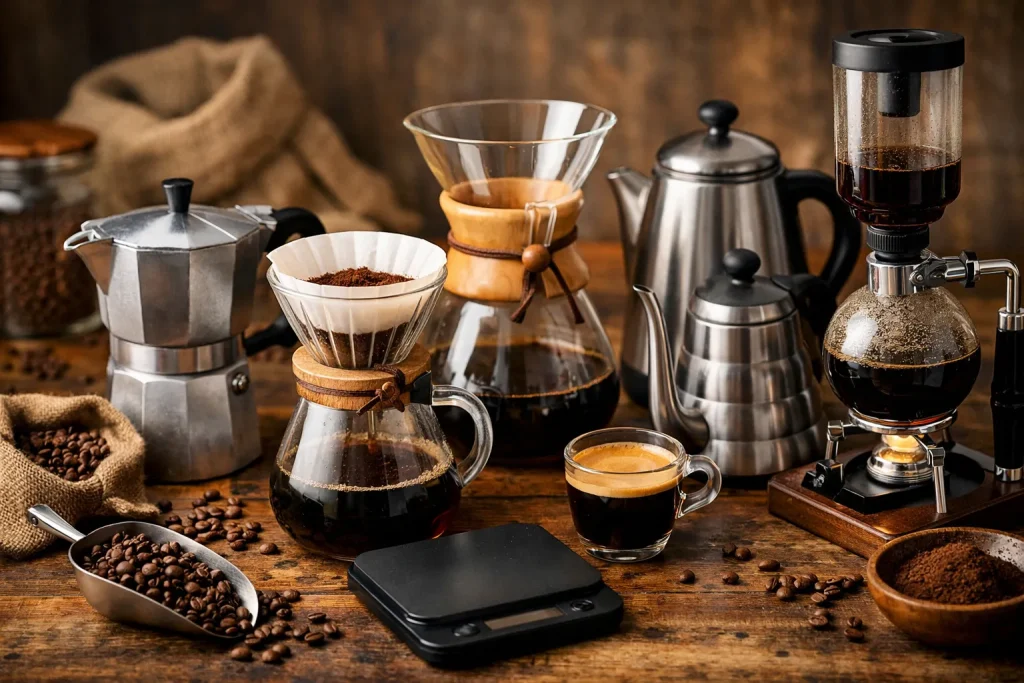
This section defines common brewing styles, key variables, and what each method produces in flavor and body. It highlights how grind size, water temperature, contact time, and pressure shape the cup.
Espresso-Based Drinks
Espresso uses fine grounds, high pressure (usually 9 bars), and short extraction time (20–30 seconds) to make a concentrated shot with crema. The base shot is ristretto (shorter, sweeter) or lungo (longer, more diluted) depending on water volume and extraction time.
Common drinks build on the shot by adding milk or water:
- Espresso: single or double shot served straight.
- Americano: espresso diluted with hot water for a longer cup.
- Latte: espresso with steamed milk and a thin milk foam layer.
- Cappuccino: equal parts espresso, steamed milk, and foam for a balanced texture. Baristas control taste by adjusting dose, grind, temperature, and tamping pressure. For technical background on espresso chemistry, readers can consult the Specialty Coffee Association’s resources: Specialty Coffee Association.
Pour-Over and Drip Coffee
Pour-over and drip methods use a paper or metal filter, medium grind, and gravity to extract coffee. The pour-over gives more manual control: bloom time, pour rate, and total brew time change clarity and sweetness.
Key pour-over types:
- V60: cone-shaped dripper that emphasizes clarity and bright acidity.
- Chemex: thicker paper filters produce a clean, body-light cup.
- Automatic drip: consistent, hands-off brewing for daily convenience. Grind size ranges from medium-fine (V60) to medium-coarse (Chemex). Water temperature around 92–96°C (197–205°F) and a 2:15–1:17 coffee-to-water ratio are common starting points. For method histories and comparisons, consult a reliable coffee reference like Wikipedia’s brewing method pages: Coffee preparation.
Immersion Techniques
Immersion methods soak grounds fully in water, then separate by pressing or filtering. They produce fuller body and pronounced sweetness because extraction is uniform over time.
Popular immersion brews:
- French Press: coarse grounds steep 4 minutes then press a metal plunger. It yields rich oils and heavier mouthfeel.
- AeroPress (immersion/pressure hybrid): short steep and manual plunge give espresso-like intensity or clean filter-style cups depending on filter and recipe.
- Cold Brew: very coarse grounds steeped in cold water for 12–24 hours, producing low acidity and smooth sweetness. Control steep time, grind, and agitation to tune strength and clarity. Immersion is forgiving for beginners but sensitive to particle size for clean extraction.
Roasting and Bean Descriptions
Roasting changes bean color, weight, and flavor through time and temperature. Bean origin, roast level, and processing method together shape acidity, body, and aroma.
Roast Levels Defined
Roast levels describe how long and how hot a roaster heats the beans. Common terms are Light, Medium, and Dark.
Light roasts keep more origin character, higher acidity, and brighter fruit or floral notes. They weigh more because less moisture is lost and often show tasting notes like citrus or tea-like clarity.
Medium roasts balance acidity and body. They bring out sweetness, caramelized sugar, and more rounded flavors. Many specialty shops use medium roasts to highlight balance.
Dark roasts emphasize body and roast-derived flavors like chocolate, toasted nuts, or smoke. They mask some origin traits and reduce acidity. Degree names include Full City, Vienna, and French.
Single Origin vs. Blend
Single origin means beans come from one country, region, or farm and show distinct terroir-driven flavors. They let tasters identify origin traits like floral Ethiopian, chocolatey Colombian, or bright Kenyan acidity. Single origins suit pour-over and brewing methods that highlight clarity.
Blends combine beans from different origins or roast levels to create consistency and complexity. Roasters use blends to balance acidity, body, and sweetness across seasons. Blends work well for espresso because they can provide both crema and a stable flavor profile under pressure.
Buyers should check labeling for harvest year and farm information to judge freshness and traceability.
Processing Methods
Processing is how cherry fruit is removed from the bean and it shapes basic flavor structure. Washed (wet) processing removes pulp quickly and ferments less; it usually yields cleaner, brighter, and more acidic cups. Washed coffees often taste crisp and floral.
Natural (dry) processing dries whole cherries on patios or raised beds; it increases fruit notes, body, and sweetness. Naturals can show jammy, berry-like flavors and heavier mouthfeel.
Honey (pulped natural) leaves some mucilage during drying, giving a middle ground: more sweetness than washed, less fruitiness than natural.
For technical details on processing and best practices, World Coffee Research offers research-based guidance, and the Specialty Coffee Association publishes standards and definitions for processing methods: World Coffee Research, Specialty Coffee Association.
Tasting and Flavor Terminology
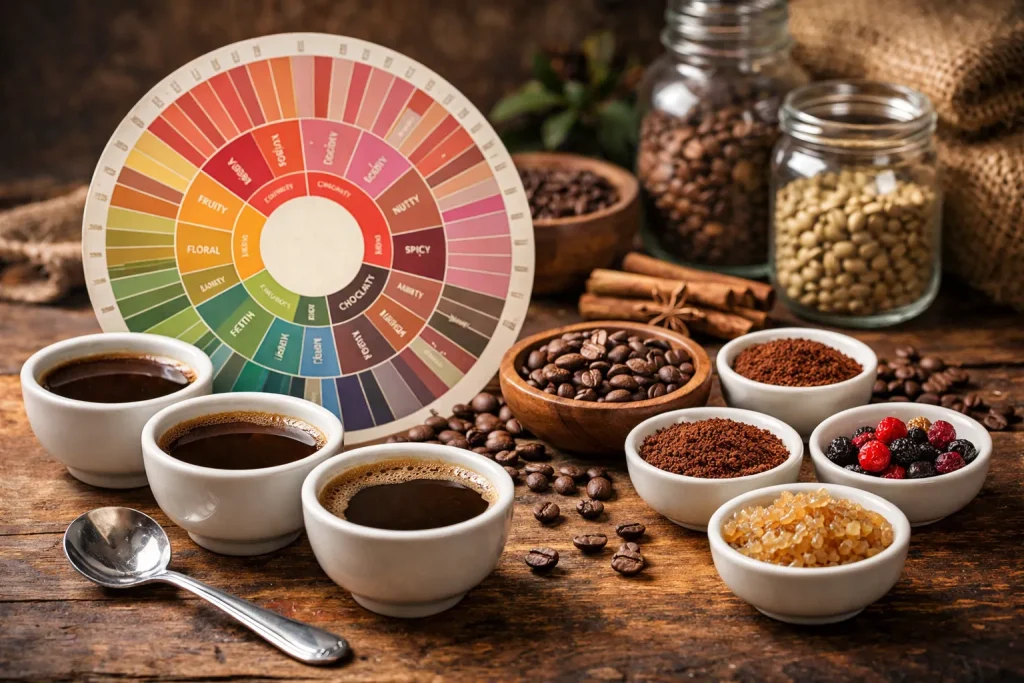
This section breaks down the words people use to describe coffee taste and feel. It focuses on specific sensory terms that help identify origin, roast, and brewing effects.
Tasting Notes Explained
Tasting notes name distinct flavors a person detects in coffee, like cherry, caramel, dark chocolate, or citrus. These notes come from the bean’s variety, where it was grown, and how it was roasted. For example, Ethiopian coffees often show berry or floral notes, while Brazilian beans might show nutty or chocolate notes.
When cupping, tasters sniff the dry grounds, inhale the brewed aroma, and sip to isolate flavor layers. They describe top notes (bright, immediate flavors), mid notes (body and main flavors), and finish notes (lingering tastes). Using specific descriptors helps compare coffees and track changes across roasts or brewing methods.
Body, Acidity, and Mouthfeel
Body refers to how heavy or light coffee feels in the mouth — often described as thin, medium, or full. A full-bodied coffee can feel syrupy or creamy, while a light-bodied coffee feels more tea-like.
Acidity means the bright, lively sensation, not sourness. It ranges from soft and wine-like to sharp and citrusy. High-quality acidity gives clarity and lifts flavors.
Mouthfeel covers texture terms like oily, silky, coating, or clean. It affects how flavor carries across the palate. Brewers adjust grind size, water temperature, and extraction time to change body and mouthfeel.
Aroma and Aftertaste
Aroma is the smell of coffee before and during sipping. It includes fragrances like floral, toasted, spice, or grassy. Aroma often predicts flavor: a fruity aroma usually leads to fruity tasting notes.
Aftertaste, or finish, is what remains after swallowing. It can be short and clean, or long and evolving. Common aftertaste descriptors include bitter chocolate, nutty, citric, or herbal. A persistent, pleasant finish often signals balanced extraction and good bean quality.
Key sensory words to watch:
- Aroma: floral, roasted, fruity
- Body: thin, medium, full
- Acidity: bright, winey, citric
- Aftertaste: lingering, clean, bitter chocolate
Specialty Coffee Language
This section defines key terms used by specialty coffee professionals and graders. It highlights tasting, sourcing, and quality standards that affect how coffee is described and scored.
Third Wave Coffee Terms
Third wave coffee focuses on bean origin, roast transparency, and brewing technique. It treats coffee like wine, emphasizing single-origin lots, traceable farms, and specific harvest years. Terms such as single origin, microlot, and crop year tell buyers where and when beans came from.
Roast level vocabulary favors clarity: light roast preserves origin flavors, while city or medium roast balances acidity and body. Brewing terms matter too. Pour-over, immersion, and espresso describe methods that change extraction and flavor profile. Baristas also use mouthfeel, clean cup, and brightness to describe texture and acidity.
Supply-chain phrases appear in menus and labels. Direct trade and fair trade indicate sourcing relationships and premiums paid to farmers. Traceability and transparency mean roasters can show farm, cooperative, and processing notes.
SCA Grading Vocabulary
The Specialty Coffee Association (SCA) uses precise language for quality scoring. Graders use a 100-point scale where descriptors map to score ranges: faults lower scores, while clean cup and complexity raise them. Words like acidity, body, balance, aftertaste, and aroma have specific tasting definitions.
Scores rely on cupping forms with lines for fragance/aroma, sweetness, and uniformity. Taster notes often use single-word attributes: floral, citrus, chocolate, or nutty. Physical defects get recorded as quakers, sour beans, or moldy, which subtract from the final score.
Roasters and buyers use those scores when pricing and selecting lots. A score above 80 usually qualifies as specialty coffee. Detailed SCA vocabulary helps teams communicate exact strengths and weaknesses of a lot during procurement.
Barista and Café Jargon
This section lists the common words baristas use for service, drink prep, and customer requests. It explains what each term means and how staff use them during a shift.
Service and Preparation Terms
- Pull — A barista pulls an espresso by starting the machine pump. They watch extraction time and volume to hit target shot quality.
- Shot — The brewed espresso portion. Single and double shots differ by dose and yield; a double shot is standard for many drinks.
- Channeling — When water finds paths through the ground coffee and causes uneven extraction. Baristas look for irregular streams or blonding to spot it.
- Tamping — Compressing coffee grounds in the portafilter. Baristas aim for even pressure and a level surface to avoid channeling.
- Steaming — Heating and texturing milk with a steam wand. Microfoam indicates tiny, glossy bubbles for lattes; drier foam fits cappuccinos.
- Backflush — Cleaning the group head by running water and detergent through the machine. Shops follow regular backflush cycles to keep espresso clean.
- Grinding — Adjusting grinder settings for particle size. Baristas change grind to compensate for humidity, roast level, or espresso extraction times.
- Blind — A blind filter is used during backflush. It blocks water flow to force cleaning action inside the group head.
Drink Customization Vocabulary
- Short/Long — Short means smaller volume (often less milk) and long means larger. Customers ask for short if they want stronger coffee.
- Wet/Dry — Wet refers to more steamed milk and less foam. Dry means less milk and more foam, common in cappuccino preferences.
- No foam / extra foam — Explicit foam instructions change steaming technique and milk texture. Baristas confirm when orders are busy.
- Ristretto — A shorter, more concentrated espresso shot. It uses less water and often tastes sweeter or more intense.
- Macchiato — Traditionally an espresso “stained” with a small dollop of milk foam. Shops may serve variations; staff clarify size and style.
- Flat white — Made with a double shot and thin, velvety microfoam. It uses less foam than a latte and keeps espresso flavor forward.
- Room temp / kid’s temp — Temperature modifiers for milk. Kid’s temp is cooler than standard and is used for children or sensitive customers.
- Syrup / sauce requests — Baristas measure syrups in pumps and sauces by weight or spoon. They note “extra” or “half” to keep flavor balanced.
Equipment and Tool Names
This section lists the main machines and tools a brewer or barista will use. It names parts that affect grind size, extraction, and drink consistency.
Espresso Machines and Grinders
Espresso machines come in three common types: manual lever, semi-automatic, and fully automatic. Key parts include the portafilter, group head, boiler or heat exchanger, steam wand, and pressure gauge. The portafilter holds the puck of ground coffee. The group head disperses hot water evenly across the puck. Boilers control temperature and pressure; consistent temperature matters for shot stability.
Grinders fall into two main styles: burr and blade. Burr grinders use two abrasive surfaces to crush beans and produce a uniform particle size. They offer adjustable settings in microns or stepped clicks. Doserless grinders deliver ground coffee straight into a portafilter, while doser grinders collect grounds in a chamber. Grind size and distribution directly affect shot time, crema, and flavor balance.
Manual Brewing Devices
Manual brew tools include the pour-over dripper, French press, AeroPress, and siphon. Pour-over drippers (V60, Kalita Wave) use paper or metal filters and require consistent pour rates. They emphasize control of bloom, flow rate, and total brew time. French press uses immersion and a metal plunger; it yields fuller body and more oils because it skips paper filtration.
AeroPress combines immersion and pressure for a quick, smooth cup; users can vary steep time and pressure for different results. Siphon brewers use vacuum and a cloth or paper filter to produce a clean, aromatic cup with theatrical visuals. Each device has specific tools: scales, kettles with gooseneck spouts, timers, and tampers for consistent results.
Coffee Culture and Regional Terms
This section highlights how different places and communities name and talk about coffee. It shows common drink names across countries and the slang people use in cafes and homes.
International Coffee Names
Different countries give the same drink distinct names and sizes. For example, a small espresso in Italy is “ristretto” when pulled shorter, while Spain often calls a short espresso a “corto.” In Austria and parts of Central Europe, a single espresso with a little foam is a “kleiner schwarzer” or “kleiner Espresso.”
Some countries name milk-and-coffee drinks by milk ratio or cup size. A “latte” in Italy means milk, not the foamy café latte common in the U.S. In Australia and New Zealand, a “flat white” is a small, strong coffee with thin microfoam. Turkish “cezve” coffee uses very fine grounds and is served unfiltered in a small cup. In Vietnam, “cà phê sữa đá” pairs dark roast coffee with sweetened condensed milk over ice.
| Region | Common Name | Notes |
|---|---|---|
| Italy | Ristretto / Espresso | Shorter or standard pull; small servings |
| Australia / NZ | Flat White | Small, strong, thin microfoam |
| Vietnam | Cà phê sữa đá | Dark roast + condensed milk, served iced |
| Turkey / Middle East | Turkish Coffee / Cezve | Finely ground, boiled, unfiltered |
Cultural Expressions and Slang
Coffee slang reflects habits and settings. In the U.S., “cup of joe” is a casual term for coffee. Baristas say “pull” for making espresso and “shot” for the single espresso portion. In specialty cafes, customers may ask for “single-origin” to mean beans from one farm or region.
Other cultures use idioms tied to coffee. In Brazil, “cafezinho” is a small, strong offered as hospitality. In Sweden, “fika” refers to a coffee break with pastry and socializing; it signals a cultural ritual more than just a drink. In Italy, asking for “un caffè” implies a quick espresso at the counter rather than a lingering beverage. These phrases shape expectations about size, strength, and how the drink will be served.
FAQS
What is “specialty coffee” versus regular coffee?
Specialty coffee refers to beans scored 80 or above by certified tasters. It often has clearer flavors and higher quality control than commercial blends.
What does “single-origin” mean?
Single-origin means beans come from one country, region, or farm. It highlights specific flavor notes tied to that place.
How do “brew ratio” and “extraction” differ?
Brew ratio is the weight of coffee to water used. Extraction is how much of the coffee’s soluble material dissolves into the water. Both affect strength and taste.
Why do roasts change flavor?
Roasting drives chemical changes in the bean. Lighter roasts keep more origin flavors; darker roasts add caramelized and smoky notes.
How important is grind size?
Grind size controls extraction speed. Finer grinds extract faster and suit espresso; coarser grinds work best for French press.
Quick reference table
| Term | Short meaning |
|---|---|
| Espresso | Concentrated shot, high pressure |
| Crema | Foam on espresso surface |
| Acidity | Bright, lively taste |
| Body | How heavy the coffee feels in the mouth |
Can a home brewer learn tasting skills?
Yes. Tasting, or cupping, improves with practice and simple notes. Start by comparing two coffees and focus on smell, acidity, and aftertaste.
Are equipment names important to know?
Yes. Knowing terms like AeroPress, pour-over, and burr grinder helps match tools to desired results.
Conclusion
The glossary helps readers learn key coffee words and use them with confidence. It supports better choices at cafes and when brewing at home.
Knowing terms like roast level, extraction, and crema makes tasting clearer. It also helps talk with baristas and read coffee labels.
Readers can pick a few new words to practice each week. Small steps build skill and deepen enjoyment of coffee.