
Coffee History Through Centuries: A Friendly Journey From Origins to Global Culture
You travel through time with every cup you lift, tracing coffee’s path from wild plants in Ethiopia to kitchens and cafes around the world. You’ll learn where coffee began, how it spread across continents, and why it changed how people meet, work, and trade. Ethan Cole from Webrewcoffee.com shares practical tips and stories that make the history useful for your next brew.
Expect clear, short stops along the way: early legends, trade routes that shaped empires, key technology that changed brewing, and the modern scene of specialty shops and home techniques. You’ll also find simple brewing tips you can try at home to taste history in your cup.
Key Takeaways
- Coffee started as a local plant and grew into a global crop.
- Trade and technology drove coffee’s spread and changing flavors.
- Simple brewing skills and choices shape your daily cup.
Origins of Coffee
Coffee likely began in the highlands of East Africa, where wild coffee plants grew and people first noticed their effects. From small mountain forests, the bean spread through trade, travel, and local customs to become a cultivated crop.
Legend of Kaldi
A common story says a goat herder named Kaldi found his goats more lively after eating red berries. He brought the berries to a local monk, who tried them and stayed awake during prayers. The monk then shared the berries with other monks to fight sleep during long services.
This tale appears in many accounts, but historians treat it as folklore rather than verified history. Still, the Kaldi story helps explain how people first connected coffee’s stimulating effect to the berry itself.
Ancient Coffee Forests
Wild coffee species grew in the Ethiopian highlands and surrounding mountain forests. These areas provided cool temperatures, steady rainfall, and rich soil that helped coffee trees thrive without human farming at first.
People gathered wild cherries for food and for their energizing effect. Over time, locals learned to roast and brew the beans, moving from casual use to intentional preparation. These forests remained an important genetic source for many modern coffee varieties.
Ethiopian Traditions
Ethiopia kept many early coffee customs, including ritualized brewing and communal drinking. The traditional coffee ceremony involves roasting green beans, grinding them by hand, and boiling the coffee in a small pot called a jebena.
Participants often roast beans twice and serve three rounds of coffee, called abel, tona, and baraka. These practices show how coffee became woven into social life, hospitality, and ceremony long before large-scale cultivation began.
Spread of Coffee Across Continents
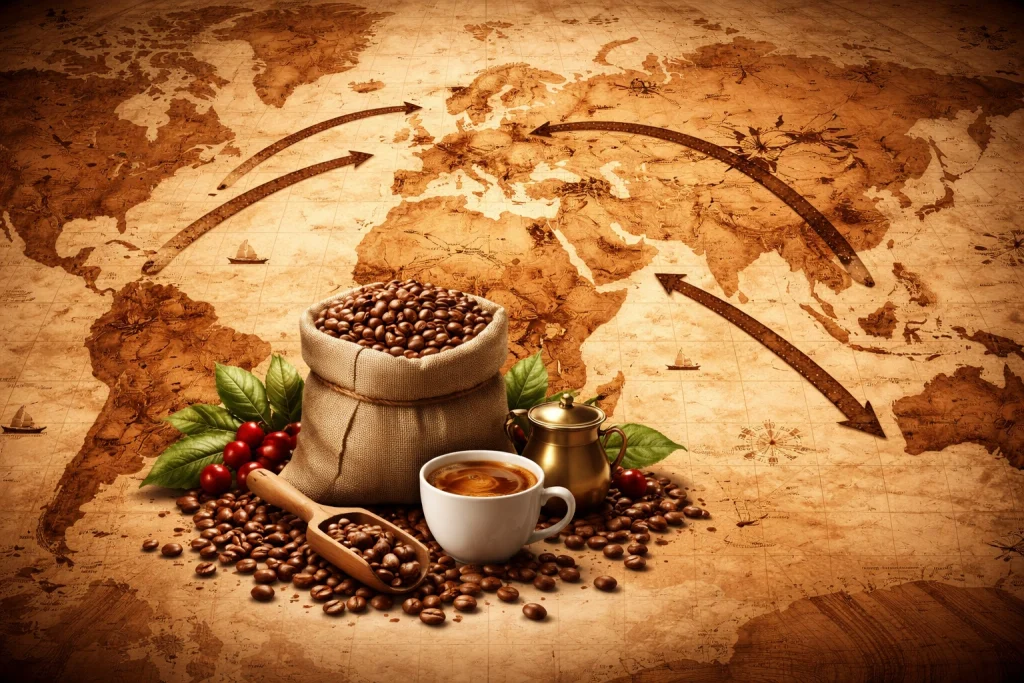
Coffee moved from East Africa into new lands through trade, religious life, and colonial agriculture. It changed daily routines, built new markets, and led to coffeehouses that shaped public life.
Coffee’s Journey to the Arab World
Coffee reached the Arabian Peninsula by the 15th century, with Yemen as the main early center of cultivation. Sufi monks used brewed coffee to stay awake during night prayers, and Yemeni port cities like Mocha became key export hubs.
Merchants tightly controlled shipment and cultivation for a time, which helped spread the beverage across the Red Sea and into the wider Muslim world. Trade routes from Aden and al-Makha carried green beans to Cairo, Mecca, and beyond.
Local roasting and brewing practices developed in markets and mosques. This early Arab trade network also shaped coffee’s vocabulary: words like “qahwa” influenced later European terms.
European Coffee Houses
Coffee arrived in Europe in the 17th century through Mediterranean trade and Ottoman contacts, first appearing in port cities such as Venice and Constantinople. Merchants, diplomats, and travelers introduced the drink, and urban coffeehouses opened quickly in cities like London and Paris.
These coffeehouses acted as meeting places for merchants, writers, and politicians. People read newspapers, debated ideas, and conducted business over cups of coffee. The social role of these houses helped spread coffee culture across intellectual and commercial life in Europe.
European demand also spurred colonial cultivation. Colonies in the Caribbean, South America, and Asia later supplied much of the world’s coffee, linking European markets to plantation agriculture overseas.
Coffee in Asia
Coffee reached parts of Asia both through European colonial routes and local trade networks. The Dutch introduced coffee to Java in the late 17th century, developing large plantations that became a model for regional production.
In Southeast Asia, colonial powers and planters expanded cultivation on islands and mainland areas. The climate in places like Sumatra and Vietnam proved ideal, and by the 19th and 20th centuries these regions became major exporters.
Asian consumption also grew. In Japan and Korea, coffee first entered through ports and modernizing cities, gaining popularity in cafes and urban centers by the late 19th and early 20th centuries.
Coffee and Global Trade
Coffee reshaped trade routes, labor systems, and national economies. It connected farms in tropical highlands to markets in Europe and North America, and it tied plantation work, merchant shipping, and price politics into a single global network.
Coffee Plantations in the Americas
European colonists moved coffee plants from Africa and the Middle East to the Americas in the 18th century. Large plantations sprang up in Brazil, Colombia, and parts of Central America where tropical climates and mountain soils suited Coffea arabica. Planters relied on enslaved and then coerced labor to clear land, plant rows, and harvest cherries during short picking seasons.
Plantation systems focused on scale and export. Processing often happened on-site: cherries were pulped, fermented, washed, and dried before shipment. Ports such as Rio de Janeiro and Buenaventura became major export hubs. For modern reference on Brazil’s role and production methods, the International Coffee Organization offers historical context.
Rise of Coffee Commerce
Merchants and shipping companies built networks to move beans from ports to urban markets. Amsterdam and London became early trading centers after European demand grew in the 17th and 18th centuries. Later, transatlantic trade routes linked South and Central American exporters to roasters in Europe and the United States.
Market systems evolved from spot trade to long-term contracts and, in the 20th century, international agreements aimed at stabilizing prices. Commodity exchanges and brokers began to set futures prices that affected farm incomes. Trade also spurred technological changes, like steamships and refrigerated storage, which sped delivery and widened markets. For more on market institutions, the International Coffee Organization has historical summaries.
Impact on Colonial Economies
Colonial governments used coffee to generate export revenue and to justify territorial control. In colonies, land policies often favored large estates. This concentrated wealth and shaped infrastructure—roads, railways, and port facilities—around export needs rather than local food production.
Local populations faced deep social effects: displacement of smallholders, changes to labor regimes, and dependency on single-crop economies. Price swings on international markets could cause hardship when yields fell or demand dropped. Over time, some producing countries pursued policies to diversify or to add value through local roasting and branding to capture more profit domestically.
Evolution of Coffee Culture

Coffee moved from a local beverage to a global social and cultural force. It shaped public life through gathering places and created strong regional traditions tied to history, trade, and preparation methods.
Coffeehouses as Social Hubs
Coffeehouses first gained fame in 17th-century cities like Istanbul, Cairo, Venice, and London. They served coffee, news, and space for debate. Merchants, writers, clerics, and students met to read letters, hear music, or discuss politics.
These rooms influenced business and ideas. In Europe, coffeehouses became venues for financial deals and newspapers. In the Ottoman world, they hosted storytelling, chess, and poetry.
Design and service mattered. Long counters, shared tables, and quick-serving brews encouraged talk. Over time, the format evolved into salons, espresso bars, and modern cafes with laptops and specialty menus.
Distinct Regional Coffee Traditions
Ethiopia kept coffee tied to ceremonies: beans roasted at home, ground by hand, and brewed in a jebena for guests. The ritual lasts hours and signals hospitality.
In the Arabian Peninsula, Yemen developed early roasting and brewing methods and spread coffee through trade routes. Turkish coffee uses very fine grounds boiled in a cezve and served unfiltered.
Europe added milk and sugar. Italy created espresso culture with short, strong shots and cafe terms like macchiato and cappuccino. In Latin America, coffee became a plantation crop shaping economies and daily drip-brew habits.
Each tradition reflects local tools, social customs, and flavor preferences, from strong, unfiltered cups to milk-forward drinks and slow ceremonial brews.
Influence of Coffee on Society
Coffee reshaped how people meet, think, and create. It supported public debate, inspired writers and artists, and became part of daily rituals around the world.
Coffee and Intellectual Movements
Coffeehouses became centers for debate and learning in 17th- and 18th-century Europe. Merchants, scholars, and writers met there to exchange news, test ideas, and read pamphlets. These spaces helped spread Enlightenment thinking by making information more available outside universities and courts.
In cities like London, Paris, and Vienna, coffeehouses hosted clubs and scientific societies. Patrons discussed politics, economics, and science. Coffee’s caffeine also helped people stay alert during long discussions and late-night study sessions.
Newspapers and journals often started in or were shared at coffeehouses. That made them hubs for public opinion and political organizing. Coffeehouses thus played a clear role in shaping civic life and the circulation of ideas.
Coffee in Art and Literature
Writers and artists commonly used coffee as both subject and fuel for work. Poets like Baudelaire and writers such as Balzac mentioned coffee in their work and daily routines. Balzac reportedly drank long hours of coffee to sustain intense writing sessions.
Coffeehouses provided scenes for novels and plays, offering settings for conversations that drive plots and character development. Painters and cartoonists captured crowded café interiors, highlighting social interplay and urban life.
Coffee also inspired a genre of essays and reviews focused on taste, ritual, and modernity. Critics and cultural commentators used coffee as a way to discuss class, leisure, and changing habits in 19th- and 20th-century cities.
Social Rituals Surrounding Coffee
Different regions developed clear rituals around coffee preparation and service. In Ethiopia, coffee ceremonies involve roasting beans, brewing in a jebena, and offering multiple rounds. The ritual marks hospitality and family bonding.
Turkish and Arabic coffee traditions emphasize thick, unfiltered brews served in small cups. Reading the grounds became a folk practice in some places. In Italy, espresso culture gave rise to quick bar visits, while Scandinavian countries favored long, communal coffee breaks called fika.
Modern coffee shops mix older rituals with new habits: remote work, casual meetings, and specialty tasting. These routines shape daily schedules, social bonds, and how people move through urban spaces.
Modern Coffee Industry
The modern coffee industry blends new brew styles, global supply chains, and rising concern for worker welfare and the environment. Big roasters, specialty cafes, and smallholder farmers all shape how coffee is grown, traded, and sold today.
Emergence of Specialty Coffee
Specialty coffee grew from quality-focused roasters like Peet’s and early third-wave cafés into a global movement. It values origin, bean variety, and careful roasting. Buyers score beans on flavor, and scores above 80 (out of 100) often earn the “specialty” label.
Third-wave shops focus on single-origin beans, lighter roasts, and brewing methods like pour-over and espresso with precise ratios and temperatures. This pushed barista training, equipment innovation, and direct trade relationships that pay farmers premiums for higher quality.
Specialty coffee also created new markets for traceability. Consumers now expect information on farm, processing, and farmer names. This led to partnerships with organizations such as the Specialty Coffee Association and resources like the USDA coffee trade data for reliable sourcing.
Global Coffee Production Leaders
Brazil, Vietnam, and Colombia lead global coffee production by volume. Brazil dominates Arabica output and large-scale farm systems. Vietnam focuses mainly on Robusta, which supplies instant coffee and espresso blends.
Colombia and Ethiopia are prized for distinctive Arabica flavors linked to altitude and heirloom varieties. Smaller producers in Central America, East Africa, and Indonesia supply niche markets and high-altitude specialty lots that command higher prices.
Coffee exports depend on weather, pests, and market prices. Trade flows use commodity exchanges and direct exports to roasters in the U.S., Europe, and Japan. Governments and cooperatives often shape export rules and support services that affect farmer incomes.
Sustainability Trends
Sustainability now targets climate risk, fair pay, and eco-friendly practices. Many farms adopt shade-grown systems, agroforestry, and soil-restoration to protect yields and biodiversity. These methods help farmers adapt to rising temperatures and shifting rainfall.
Certification schemes like Fair Trade, Rainforest Alliance, and organic labels aim to improve labor conditions and market access. Critics note that certification premiums vary and that direct trade or living wage programs can sometimes deliver more benefit.
Roasters and retailers increasingly invest in farmer training, traceability tools, and carbon-reduction plans. Companies link sustainability reporting to targets for emissions, water use, and reforestation on coffee land. For more on climate impacts and adaptation, readers can consult the International Coffee Organization and the Specialty Coffee Association for data and best practices.